

 Buy with Prime

Amino Acids
-
Regenerating Renewal
-
Best Seller

Tightening & Firming
-
Best Seller

Wrinkle Smoothing
-
Best Seller

Fine Lines & Wrinkles
-
Best Seller

Fine Lines & Wrinkles
-
Best Seller

Botanical Bliss
-
Best Seller

Anti-Aging Eye Cream
-

Fills & Smooths
-
Sale

Grow & Thicken
-

Dark Circle Treatment
-
Best Seller

Anti-Aging Serum & Botanicals
-

Nourishing Hydration
-

Regenerating Renewal
-
Sale

Eyelash & Eyebrow Serum
-

Non Greasy Gel Hydration
-
Sale
Daily Exfoliation & Moisture


What Are Amino Acids in Skincare?
Amino acids are small, water-soluble molecules that link together to form peptides and proteins such as collagen, elastin and keratin. In skincare they appear two ways: as free amino acids (glycine, serine, arginine, proline) that act as humectants and help the skin's surface hold water, and as short amino acid sequences called peptides that are designed to support the look of firmer, smoother skin.
 EWG Skin Deep rating for Amino Acids
A common mix-up: amino acids and peptides are not the same thing. A peptide is a chain of amino acids. Cosmetic peptides usually contain about 3 to 30 amino acids, while a single amino acid is one building block.
Quick Facts
| Property | Detail |
|---|---|
| INCI names | Listed individually, for example Glycine, Serine, Arginine, Proline, Alanine, Lysine. Peptides use names such as Acetyl Hexapeptide-8 or Copper Tripeptide-1. |
| Common names | Amino acids, free amino acids, NMF amino acids, peptides (when linked) |
| Source | Fermentation, plant protein hydrolysis, or sequence assembly in a lab |
| Form | White powders; peptides are often sold pre-dissolved as liquid serum boosters |
| Solubility | Water. Most do not dissolve in oil. |
| Typical usage rate | Varies by ingredient. Skin Perfection product page rates: GHK-Cu powder 1% (1 g per 100 ml), Argireline 10% (90 drops per fl oz), Snap-8 10% (90 drops per fl oz), Syn-Ake 5% (45 drops per fl oz) |
| pH | Follow each supplier sheet; most peptide boosters are formulated for water-based products in the mildly acidic to neutral range |
| Skin types | All skin types, including dry and mature skin |
How Amino Acids Work on the Skin
Free amino acids and hydration
The outer layer of skin, the stratum corneum, holds water with a blend of small molecules called natural moisturizing factor (NMF). Free amino acids are the largest part of it. A 2016 paper by Arezki and colleagues in the International Journal of Cosmetic Science summarizes the published composition: free amino acids make up about 40% of NMF, with serine the most abundant (about 36% of the amino acid fraction), followed by glycine (about 22%) and alanine (about 13%). That work was lab research on a model membrane, not a human trial, but the composition figures it reports come from earlier human skin studies. This is why glycine, serine and arginine show up in hydrating toners and serums: they mimic what healthy skin already uses to stay soft.
The same paper notes that hot water depletes these amino acids. In a human study it cites, soaking forearm skin in 40°C water for 10 minutes caused a measurable loss of total amino acids from the stratum corneum. Long hot showers and harsh cleansers leave skin feeling tight for a reason.
Peptides and the look of firmness
Peptides are amino acid sequences built to send a specific message. Reviews group them into four families: signal peptides (associated with collagen and elastin support), carrier peptides (deliver trace minerals such as copper), neurotransmitter-affecting peptides (soften the look of expression lines), and enzyme-inhibiting peptides. In a double-blind, placebo-controlled study, Robinson and colleagues (2005) had 93 women apply palmitoyl pentapeptide to the face for 12 weeks; expert graders measured an improvement in the appearance of fine lines and wrinkles compared with the placebo.
Supplier data adds detail for individual sequences. Sederma's Matrixyl 3000 technical document describes a 2-month, placebo-controlled test in which volunteers applied a cream with 3% Matrixyl 3000 twice daily to one half of the face and the forearm (supplier data). Read supplier figures as a starting point, not as independent proof.
How to Use Amino Acids and Peptides
- Water phase only. Add free amino acids and peptide boosters to the water phase of a serum, gel or lotion. They do not blend into straight oils.
- Add below 40°C (104°F). Heat can break down peptide sequences. Stir them in during cool-down or into a finished, preserved base.
- Use the full manufacturer rate. A peptide below its tested rate is mostly label decoration. At the Skin Perfection house rate of 9 drops = 1% per fl oz, Argireline at 10% is 90 drops in 1 oz of base.
- Watch strong acids. Very low pH products, such as high-strength glycolic peels, can reduce peptide stability. Use peptides and acids at different times of day.
- Storage. Keep boosters capped, out of light, and refrigerated if the label says so. Use finished DIY serums within the shelf life of the preservative system.
Who Amino Acids Suit
Free amino acids are among the gentlest hydrators available and suit nearly every skin type, from oily to very dry. Peptides are popular with mature skin and with anyone who wants a non-acid, non-retinoid option for the look of fine lines. Sensitive skin: patch test on the inner arm for 24 hours and start at the lowest rate on the product's recommended range, then work up.
Frequently Asked Questions
Are amino acids good for your skin?
Yes. Free amino acids make up about 40% of the skin's natural moisturizing factor, so they help the surface hold water and feel soft. Linked into peptides, they are also used for the look of firmer, smoother skin.
What is the difference between amino acids and peptides?
Amino acids are single building blocks. Peptides are short chains of them, usually about 3 to 30 amino acids long. Both are water-soluble and can be used in the same serum.
Which amino acids are best for skin?
Serine, glycine and alanine are the most abundant amino acids in the skin's natural moisturizing factor, so they are common in hydrating products. Arginine and proline also appear often. For firmness, choose a tested peptide such as Argireline, Matrixyl 3000 or GHK-Cu at its full rate.
Can I use amino acids or peptides with vitamin C or retinol?
Generally yes. Layer sensibly, and keep very low pH products such as strong acid peels at a different time of day from peptide serums.
Are amino acids good for sensitive skin?
Free amino acids are among the gentlest hydrators available. Patch test new products on the inner arm for 24 hours, and with peptide boosters start at the lowest rate on the product's range.
Does eating protein do the same thing as topical amino acids?
Diet supplies amino acids for the whole body. Topical amino acids and peptides act at the skin's surface, where they are formulated to be used, so the two are not interchangeable.
Shop Amino Acid and Peptide Products
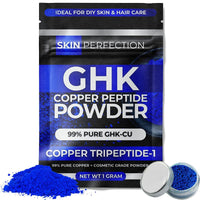
To work with a carrier peptide, start with our GHK-Cu Copper Peptide Powder, or try a ready-to-use option like the Foaming Peptide Cleanser. All products in this collection are shown below. For recipes and a full guide, see Peptides in Skincare: A Cosmetic Formulator's Complete Guide, and read more on natural moisturizing factor and copper peptides.
Sources
- Arezki NR, Williams AC, Cobb AJA, Brown MB. Design, synthesis and characterization of linear unnatural amino acids for skin moisturization. International Journal of Cosmetic Science. 2016;39(1):72-82. PMC5244679
- Robinson LR, Fitzgerald NC, Doughty DG, Dawes NC, Berge CA, Bissett DL. Topical palmitoyl pentapeptide provides improvement in photoaged human facial skin. International Journal of Cosmetic Science. 2005;27(3):155-160. PubMed 18492182
- Pintea A, Manea A, Pintea C, et al. Biomolecules. 2025;15(1):88 (review of cosmetic peptide categories and clinical evidence). doi:10.3390/biom15010088
- Sederma, Matrixyl 3000 technical document (supplier data).
- Skin Perfection product pages: GHK-Cu Copper Peptide Powder, Argireline, Snap-8 and Syn-Ake usage rates.
These statements have not been evaluated by the Food and Drug Administration. These products are not intended to diagnose, treat, cure, or prevent any disease.
About the Author
Written by Kari Thomas, cosmetic formulator and founder of Skin Perfection.