

 Buy with Prime


Search for advice about stem cell in cosmetics and you'll meet the same line everywhere: buy the serum, because stem cells tell your skin to behave younger. That advice has the logic backwards. The word on the label describes a marketing category, not a preparation, and it tells you nothing about which plant or cell line the material came from, how much of it sits in the jar, what carries it into the skin, or what anyone measured on a human face.
The money riding on that word is real. Astute Analytica valued the broader plant stem cells market at USD 396.1 million in 2023 and projected USD 855.3 million by 2032, with cosmetics applications contributing over 47% of revenue. None of that growth requires a single buyer to know what they're applying.
The useful question isn't whether stem cells work. It's which preparation, at what dose, in which formula, produced what measured outcome. Answer that for the specific product in front of you and the label stops being a mystery.
Table of Contents
- What Stem Cell Ingredients Are in a Cosmetic Jar
- What the Apple Stem-Cell Trial Shows and Where It Stops
- Are Stem Cell Cosmetics Legal and Who Sets the Rules
- Which Claims Describe Appearance and Which Imply Treatment
- How to Check a Stem Cell Claim Before You Buy
- Safety Questions for Secretome and DIY Formulas
- Choose a Product With Claims You Can Verify
What Stem Cell Ingredients Are in a Cosmetic Jar
A "stem cell" label on a cosmetic almost never means living human cells reaching your skin. It rarely means living plant cells either. Three different preparations get sold under the same phrase, and each one carries a different evidence standard.
Plant cell extracts carry most of the human evidence
The commonest version is a plant stem-cell extract or a cultured plant-cell product. The cells are grown in a controlled culture, processed, and the resulting material carries secondary metabolites such as polyphenols, flavonoids and triterpenes. Those compounds act as antioxidants, support barrier function and modulate inflammatory signalling, and the human data is extract-specific. A review of plant stem cell cosmetics reports clinical findings for apple and argan stem-cell extracts linked to reduced crow's-feet appearance and increased skin density, and for a samphire-derived extract linked to improved moisturization and a soothing effect. That finding covers the tested preparation, not every serum that prints the same botanical name.
Conditioned media is a signalling mixture, not an extract
Conditioned media, also called secretome, comes from cultured mammalian stromal cells. It contains cytokines and growth-related mediators that may influence keratinocyte and fibroblast behaviour through paracrine signalling, which is why formulators reach for it. A review of stem-cell secretomes identifies promise for skin rejuvenation while stressing the need for safety standards, regulatory evaluation and ways to preserve efficacy. Composition shifts with donor source, cell passage, oxygen level, culture medium, harvest timing, purification and storage, so two batches sold under one name can behave differently.
Living human stem cells are the third item in the taxonomy and the one you won't find in a cosmetic jar. Viable cells that can engraft into tissue belong to medical settings and medical rules, not to a leave-on cream making appearance claims.
| Ingredient type | What it is | Where it appears | Evidence level |
|---|---|---|---|
| Plant stem-cell extract | Extract or cultured plant-cell product rich in polyphenols, flavonoids and triterpenes | Serums, lotions and boosters, often liposome-encapsulated | Small human trials for specific extracts such as apple and argan |
| Stromal-cell secretome (conditioned media) | Signalling proteins from cultured mammalian stromal cells | Professional and DIY formulas with variable sourcing | Mostly preclinical; composition changes with each batch |
| Living human stem cells | Viable cells that can engraft into tissue | Not a cosmetic ingredient; used only in medical settings | Clinical evidence limited to medical use under medical rules |
Delivery is where a good extract often loses its advantage. Liposomal encapsulation is one documented approach intended to improve deposition and protect actives, but topical delivery has to be verified for the finished formula. A cell-culture result showing an extract does something interesting to a fibroblast doesn't tell you that the same amount crosses the stratum corneum in your jar.
What to look for on a label: a named botanical and tissue, a stated marker compound, a disclosed percentage, and a vehicle you can identify. "Stem cell complex" answers none of those.
The naming problem extends into neighbouring categories too. If you want to see how abstract the language gets, browse the exosome skincare guides, where products are sold with the same confidence and a comparably thin naming convention. What decides whether a product is worth your money is the standardized extract and its marker concentration, not the phrase on the front of the box.
What the Apple Stem-Cell Trial Shows and Where It Stops
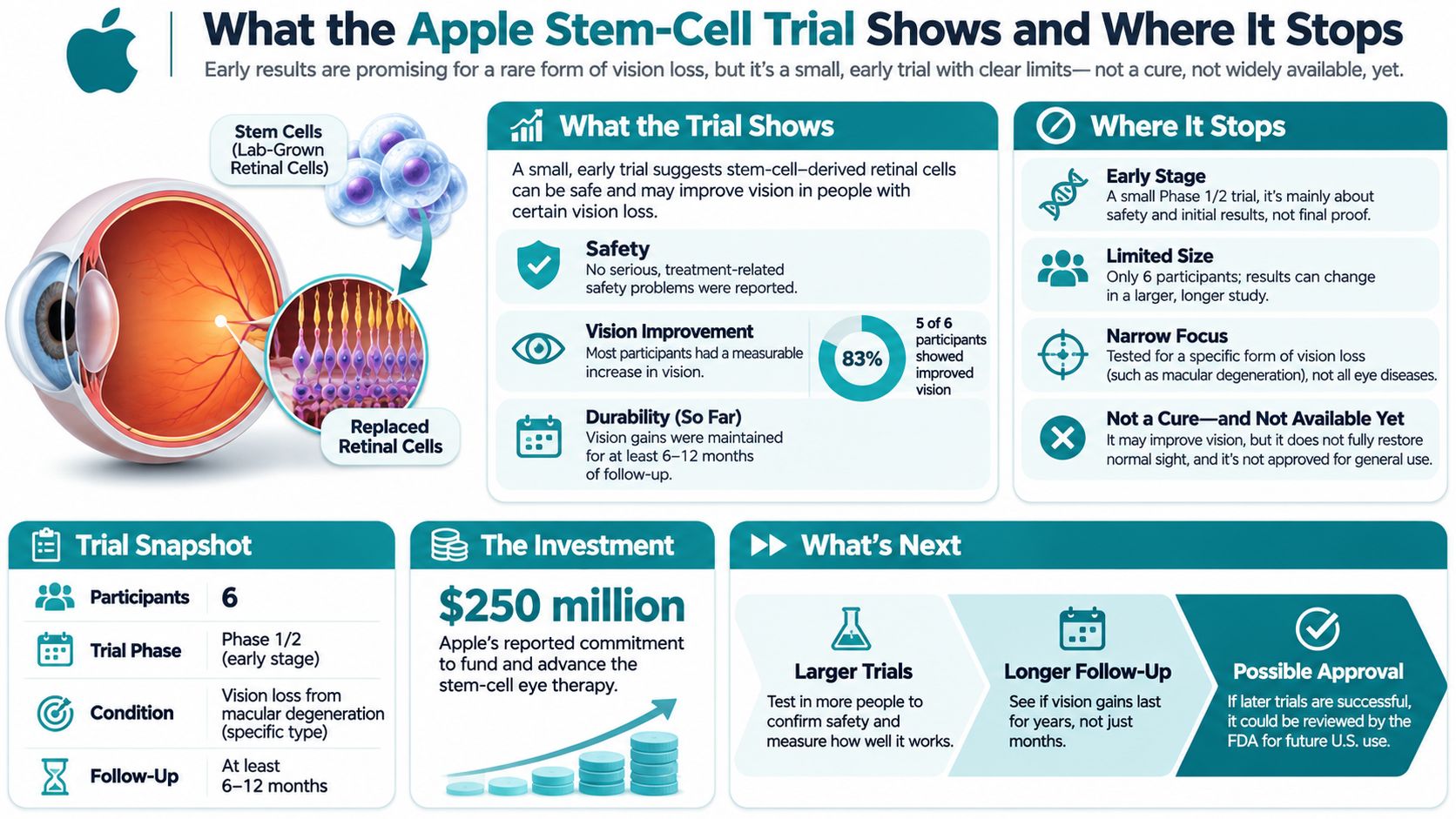
The strongest measured result behind apple stem-cell cosmetics is 15%, and it comes from a single small trial. In the trial published in the Journal of Cosmetic Dermatology, a cream containing 2% liposome-encapsulated apple stem-cell extract reduced measured wrinkle depth in the crow's feet area by 8% after two weeks and 15% after four weeks, and the report states that 71% of participants experienced a clinically relevant anti-wrinkle effect while 68% showed visible improvement as early as seven days. Every one of those figures is real, and every one shrinks once you know what was tested.
The trial is small enough to summarise in a single panel.
The study enrolled 20 women aged 37 to 64 who applied the cream twice daily for four weeks. Wrinkle depth was assessed with the PRIMOS three-dimensional optical measurement system rather than by a clinician's eyeball, and that choice is what makes the result worth reading: an instrument produces a number you can compare, an opinion doesn't.
| Measure | Reported result | What it tells you |
|---|---|---|
| Participants | 20 women aged 37-64 | Small sample, so results are preliminary |
| Formula | Cream with 2% liposome-encapsulated apple stem-cell extract, applied twice daily | Specific product, not a general "stem cell" effect |
| Duration | Four weeks | Short; no long-term data in this report |
| Wrinkle depth reduction at 2 weeks | 8% | Measured with 3D optical imaging |
| Wrinkle depth reduction at 4 weeks | 15% | Same method; appearance outcome only |
| Participants with clinically relevant anti-wrinkle effect | 71% | Reported within the same small sample |
| Visible improvement by day 7 | 68% | Early response, not a long-term result |
Where the numbers stop
The ingredient was a plant-cell extract, not living human stem cells, so nothing here describes cells implanting or rebuilding tissue. The tested object was the finished cream, which means the published figures don't separate how much of the change came from the apple extract and how much from the base it sat in. Twenty participants over four weeks is a proof of concept for a measurable appearance claim. It isn't evidence of long-term regeneration or a reversal of biological ageing, and no honest reading of it says otherwise.
There is a second, quieter limitation. The ingredient name on a jar tells you none of the variables that produced these numbers: which preparation of apple extract, at what concentration, in which vehicle, under what test. A listing that borrows the 15% figure borrows all four conditions with it, whether it matches them or not.
A rule for reading any percentage
When a listing quotes a number, ask four things: how many people, over how long, measured how, and whether the tested product is the one being sold. This trial answers all four cleanly: 20 people, four weeks, three-dimensional optical imaging, and a specific 2% cream applied twice daily. A percentage attached to a different base, a different concentration or a different use schedule belongs to that study, not to your jar.
Growth factor and signalling ingredients sit in a related but separate category, and our growth factor skincare guides cover how they're named and compared.
Apple extract is also sold as a standalone booster. PhytoCellTec Malus Domestica - Apple Stem Cells is a cosmetic-grade apple stem-cell extract for external use, intended for adding to an existing serum or a homemade lotion. Adding a booster to your own base doesn't reproduce the trial above. The trial's cream, its concentration and its application schedule were all part of the test, and a homemade mixture replicates none of them by default.
Are Stem Cell Cosmetics Legal and Who Sets the Rules
Legality depends on what the seller says the product does, and that judgement draws on the whole marketing picture rather than the package alone.
FDA's explanation of cosmetic versus drug defines cosmetics as products applied to the body for cleansing, beautifying, promoting attractiveness or altering appearance. A product becomes a drug when its labelling, advertising, website or promotional content presents it as intended to diagnose, cure, mitigate, treat or prevent disease, or to affect the structure or function of the body. The agency notes specifically that claims made on the internet can establish intended use, so a product page, a listing description and a social caption all feed the same judgement.
No approval exists to point to. FDA's guidance on cosmetic labeling claims states that the agency doesn't preapprove cosmetic products or keep a list of approved claims, and that participation in the Voluntary Cosmetic Registration Program can't be used to suggest official approval, which the regulations specifically prohibit implying. A jar labelled "FDA approved" is therefore a warning sign in itself, since no such approval pathway exists for cosmetics at all.
Medical products travel a different route. A review of the global regulatory picture notes that in the European Union, Regulation (EC) No 1394/2007 set the framework for Advanced Therapy Medicinal Products covering gene-therapy, somatic-cell-therapy and tissue-engineered products, which need authorization through the European Medicines Agency, while in the United States the 21st Century Cures Act of 2016 created the Regenerative Medicine Advanced Therapy designation for qualifying regenerative medicines. FDA oversight of human cell and tissue products runs through Section 361 of the Public Health Service Act and Section 351 of the Federal Food, Drug and Cosmetic Act. The FDA consumer alert on regenerative medicine products including stem cells and exosomes warns that many illegally marketed products of this kind haven't been shown safe or effective and identifies serious risks, including tumor formation. Those warnings concern medical products and shouldn't be read onto a conventional topical plant extract, which is exactly the distinction most marketing blurs.
Marketplaces add a stricter layer. Etsy's medical claims policy bans listings claiming an item can treat, mitigate, diagnose or cure a disease or medical condition, claiming equivalence to a prescription drug, analgesic, antibiotic, antiseptic, antiviral, anti-inflammatory, steroid, vaccine or decongestant, or claiming FDA approval, regardless of whether the claim is accurate or legal elsewhere. A seller can satisfy federal cosmetics law and still lose the listing.
| Regulatory layer | What it requires | What it means for a listing |
|---|---|---|
| US cosmetics (FDA) | Intended use decides category; no preapproval | Appearance wording only |
| US regenerative medicine | RMAT designation under the 21st Century Cures Act; FDA oversight of human cell products | Medical route, not a cosmetic listing |
| EU advanced therapy | Regulation (EC) No 1394/2007; EMA authorization | Medicinal product, not a cosmetic |
| Etsy marketplace | Bans disease, drug-equivalence and FDA-approval claims | Stricter than law in some markets |
The line that matters: an appearance claim keeps a product a cosmetic, and a biological promise moves it toward medicine, whatever the jar is called.
The practical consequence for buyers is that a compliant listing tells you less, not more. Sellers who stay inside cosmetics law describe how skin looks after use, because anything stronger would pull the product into a regulatory category it hasn't passed through. Our own copy follows these rules, and our cosmetic regulations guides walk through how intended use is assessed in practice.
Which Claims Describe Appearance and Which Imply Treatment
A cosmetic is judged by what it's presented as doing. Ingredient lists don't grant permission; sentences do, and the sentence can appear in a listing title, a product description or a comment reply.
Appearance language describes how skin looks. Treatment language promises a change in biology or a medical outcome, and FDA's overview of cosmetics law names examples it treats as drug claims even inside beauty marketing: restoring hair growth, reducing cellulite, treating varicose veins, and regenerating cells. The issue can come from an explicit promise or from an implied one carried by the overall marketing context.
| Wording in a listing | How it reads | Why it matters |
|---|---|---|
| Smooths the look of fine lines | Appearance claim | Describes how skin looks |
| Helps skin look more radiant | Appearance claim | Focused on visible effect |
| Visibly firmer-looking skin | Appearance claim | Measured as appearance, not biology |
| Restores hair growth or thickens the scalp | Treatment claim | Promises a biological outcome |
| Reduces cellulite or varicose veins | Treatment claim | Targets body structure or function |
| Regenerates cells or repairs tissue | Treatment claim | Implies biological restoration |
| Heals or treats a skin condition | Treatment claim | Implies a medical outcome |
One rewrite that shows the move
Take a line that appears on stem-cell serums constantly: "regenerates your skin cells." Rewrite it as "helps skin look smoother and more even" and the promise stays inside appearance. The formula hasn't changed. The claim has moved from biology to a visible result, and that's the only territory a cosmetic listing can defend without turning the product into a drug.
The rewrite only works if it stays honest about what the formula does. Swapping "regenerates" for "rejuvenates" doesn't fix anything, because the implied promise is the same and the reader hears the same thing.
If a claim would need a clinical trial in a medical setting to be true, it belongs to medicine, not to a cosmetic listing.
Two habits keep listings clean. Avoid comparing a cosmetic to a prescription medicine, in either direction, since equivalence language trips both FDA intended-use rules and marketplace bans. And never hint at medical approval: no badge, no "FDA registered" line, no phrasing that lets a reader conclude a regulator vetted the jar.
How to Check a Stem Cell Claim Before You Buy
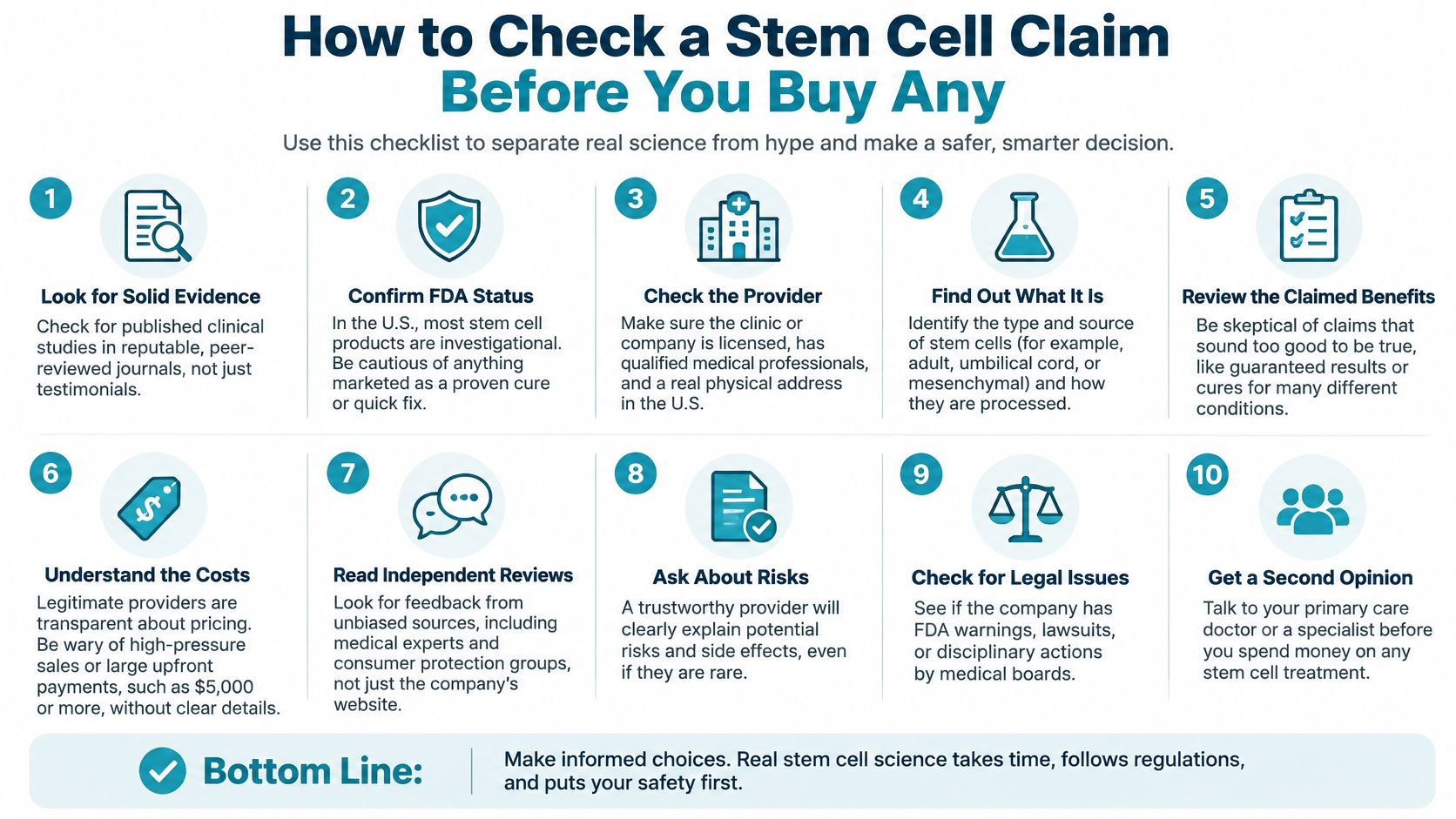
Seven questions turn a stem-cell label into something you can evaluate. Ask them in order, and most products eliminate themselves by question three, because the label rarely tells you which preparation, dose, vehicle and test stand behind the claim.
- Identify the source precisely. Ask which plant, which tissue and which cell line, because "stem cell" alone identifies nothing you can check. A trademarked ingredient name is branding, not identification.
- Confirm the standardized active and its marker concentration. A named extract with a stated marker compound can be compared across products; a "stem cell complex" can't. What goes wrong here is reading a percentage of complex as a percentage of active.
- Check the vehicle and delivery system. Encapsulation and base formula change how much material reaches the skin, and the same extract in a light serum and a rich cream aren't interchangeable. A liposome in the ingredient list does not, by itself, prove delivery.
- Find the tested endpoint and how it was measured. Three-dimensional optical measurement of wrinkle depth gives you a number; a visual rating gives you an opinion. Buyers regularly treat a before-and-after photo as an endpoint, and it isn't one.
- Note the sample size and the duration. A small, short study gives a preliminary signal and nothing more. One trial's headline percentage is the average outcome of that specific group, not your expected result.
- Check that the tested formula matches what's on sale. A published result belongs to a specific base, concentration and use schedule. The quiet assumption behind most marketing is that a branded ingredient reproduces the published result in any formula it enters, and nothing in the evidence supports that.
- Confirm stability and storage guidance. Actives degrade with heat and light, so an instruction to refrigerate the bottle or keep it opaque is part of the product, not a footnote. Decanting into an unlabelled jar on a sunny shelf undoes whatever the formulator controlled.
If the ingredient list is where you started, our guide to reading a skincare label by INCI shows how to locate the extract and where it sits in the list, which tells you something about concentration before you even reach the claims.
Why the sixth question decides most cases
A 2025 review of 38 publications found that the evidence for stem-cell cosmetic applications remains application-specific and that adequate clinical trials are still needed for each use. That finding is the reason question six exists. Results attach to preparations, not to phrases. A formula that swaps the base, changes the percentage or adds three other actives is a different preparation, and the published number no longer describes it.
The three categories from earlier in the article diverge in practice. A plant stem-cell extract can at least be pinned to a marker compound. A secretome-based ingredient varies batch by batch, so the questions about source and processing carry more weight. A claim implying living human cells in a jar fails at question one, because a cosmetic cream cannot keep them alive.
A percentage without a sample size, a duration and a method is decoration.
A claim passes when the first six questions are answered with data rather than adjectives. If a listing can't tell you the source, the marker, the vehicle, the endpoint, the sample and the match, the answer is unverified.
Safety Questions for Secretome and DIY Formulas
Two bottles labelled conditioned media can hold different materials, and that's the safety problem before anything biological enters the conversation. The variables sit upstream, in how the cells were grown, how the medium was harvested and how it was purified, so the batch record matters more than the front label.
When you buy a secretome-based ingredient, ask the supplier five things. Cell origin and donor screening, because the source determines the risk profile. Processing and purification steps, because filtration and concentration change what survives. Microbial and endotoxin controls per batch, because a culture-derived liquid is a good medium for more than your skin. Preservative compatibility with your formula, because the preservative that works in a gel may fail in a cream. Stability data for the finished product, because a number from the day of manufacture tells you nothing about week eight.
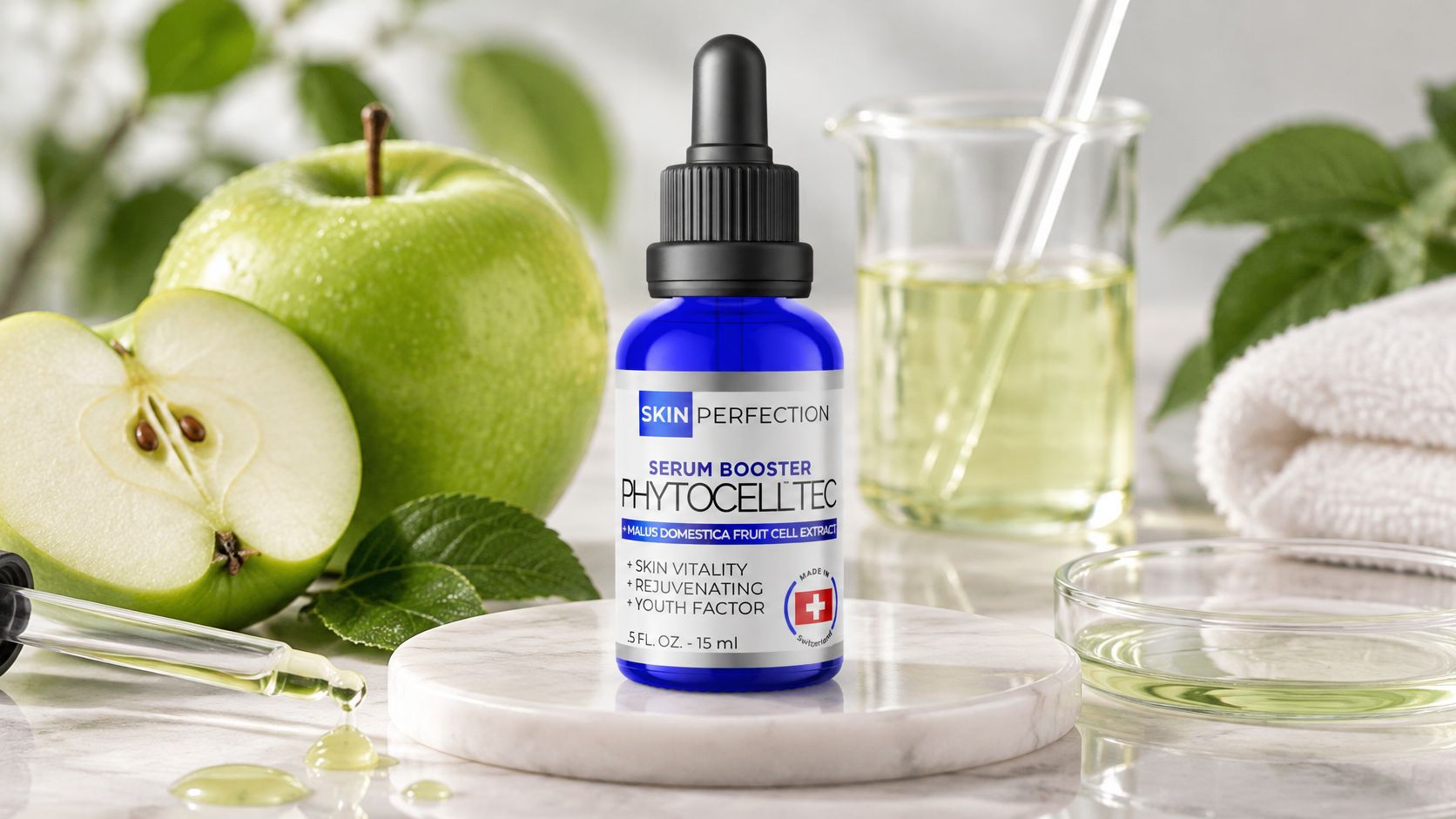
For DIY formulators the trap is arithmetic. Adding a branded ingredient to a recipe doesn't reproduce a published result, because dose, vehicle and pH all shift the outcome, and a home kitchen can't verify deposition on skin. All Skin Perfection products are cosmetic grade and for external use only, which sets the boundary: they're made for appearance, applied to intact skin, and not for any use that breaks the skin barrier.
Preservative choice decides whether a biological ingredient stays safe in the jar, and our natural skin care preservative guidance covers how to match a system to a formula rather than guessing.
A patch test that actually tells you something
Apply a small amount to the inner forearm and leave it for 48 hours before facial use. Stop if redness, itching or swelling appears, and don't push through a reaction because the ingredient was expensive. Introduce one new product at a time and keep the rest of your routine steady, so you can attribute a reaction to the right bottle.
Anyone dealing with a medical skin condition should speak to a clinician rather than rely on a cosmetic, and that applies regardless of how the ingredient is named.
Choose a Product With Claims You Can Verify
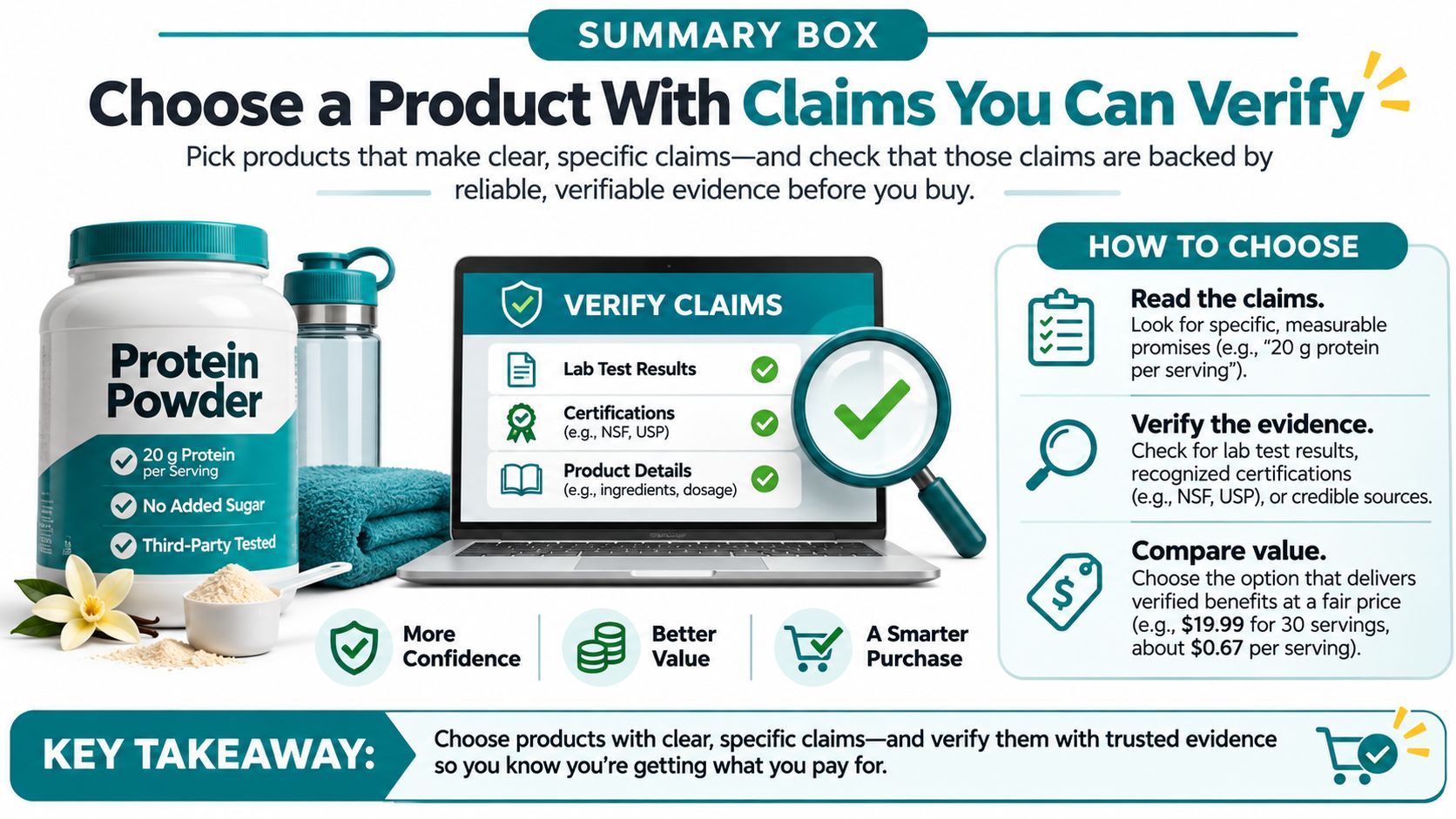
A listing that names the botanical source, states the standardized active and its concentration, describes the vehicle, and connects a tested endpoint to a sample size and a duration has earned your money. Everything else, including a striking before-and-after pair with no method behind it, stays unverified until the brand answers.
The step that turns verification into a habit is writing the answers down. Open a note, list the product name, and record what the listing provides for each question: the botanical source, the concentration, the vehicle, the endpoint, the sample size, the duration, and whether the tested formula matches the one on sale. Where the listing says nothing, write "not stated" rather than guessing. That phrase is data. A brand with two or three "not stated" entries is telling you what it can't document, and a second product evaluated the same way gives you a comparison the marketing copy never will. Over a few purchases, the note becomes your own record of which brands answer and which deflect.
Skin Perfection's skincare products are for appearance and aren't a substitute for medical care, so any concern that goes beyond appearance belongs with a clinician regardless of what the label promises.
Skin Perfection sells cosmetic-grade serum boosters and DIY lotion-making supplies for people who'd rather build and compare formulas than guess at a label. Serum Boosters let you customize your skincare with anti-aging peptides, and the shop also includes an EWG VERIFIED™ section and a guide on how to reverse engineer popular formulas. Visit Skin Perfection to browse the boosters and the supplies, then note the percentage you used and the base you used it in, so your next batch has a real comparison behind it.