

 Buy with Prime


When a cream lists collagen, does that mean it replaces collagen deeper in your skin, or helps the surface hold more water?
The distinction matters when judging results. Topical collagen can change how skin feels in the short term, while rebuilding structural collagen involves fibroblasts beneath the surface. A protein film on the outer skin can soften texture without demonstrating that anything has changed in the dermis. Smoother-feeling skin alone cannot establish that a cream has reached or influenced that deeper layer.
Human evidence has not shown that standard topical collagen rebuilds deeper skin collagen, so surface improvements should be judged separately from claims of structural repair.
Table of Contents
- Does Topical Collagen Work? The Short Answer
- Why Collagen Molecules Struggle to Reach Deeper Skin
- Topical Collagen Versus Your Skin's Own Collagen
- What Human Studies Have Measured So Far
- How to Read a Collagen Label Before You Buy
- Realistic Timeline and Your Next Step
Does Topical Collagen Work? The Short Answer
Two different claims hide inside the word "works." One is about water held at the skin's surface. The other is about structural protein rebuilt in the dermis underneath, and marketing often treats them as one. So does topical collagen work? For surface hydration, the honest answer is a qualified yes, and a narrow one. A standard collagen cream is best understood as a surface-conditioning step: it can leave a thin film, slow water leaving the skin, and make fine texture look smoother while that film is present. Whether it rebuilds anything deeper is a separate question with a much thinner record.
The scan below rates the claims people encounter on a product page. The top rows are what a buyer can reasonably expect; the bottom rows stay unproven until a finished-product human trial says otherwise.
| Claim | What the Evidence Shows | Strength |
|---|---|---|
| Surface hydration | Improved facial moisture in a human trial of a fish-skin collagen-peptide formulation | Limited |
| Skin elasticity | Improved in the same trial; a single study with no long-term follow-up | Limited |
| Smoothing of fine lines | Temporary film-forming effect; no durable change in line depth shown in people | Limited |
| Reduced water loss at the surface | Plausible film-forming barrier effect, not well measured in humans | Plausible |
| Replacing collagen lost with age | Native collagen is too large a molecule to cross the outer barrier and reach the dermis | Not supported |
| Rebuilding deep dermal collagen | Animal penetration data only; no proof in people for standard creams | Not established |
How to read that verdict
Expect the first two rows, and treat them as limited. In a human trial of a fish-skin collagen-peptide formulation, facial moisture and elasticity both improved over the study period. That is one formulation, one concentration, one timeframe, and no follow-up after people stopped using it. A measured change inside a short window is a different thing from a lasting change in skin structure.
The middle rows describe what a surface film can do. Skin can look softer while product sits on it, and no result in people shows a standard collagen cream leaving a durable change in line depth once that film is gone. Slower water loss is the most defensible mechanism, since a protein film can slow evaporation, yet trials in people rarely measure that loss directly. Plausible is the honest label.
Practical rule: If a claim needs collagen to arrive in the dermis, ask for a human trial of the finished cream, because the ingredient list cannot supply one.
The last two rows fail at the same wall. Native collagen is too large a molecule to pass the skin's outer barrier and reach the dermis, where fibroblasts assemble structural collagen. Deeper rebuilding rests on animal penetration work: it shows that fragments can move through animal skin, and it stays silent on what a standard cream does on a person's face. The same caution belongs anywhere a clinic-style claim outruns the trial behind it, which is why a careful read of stem cell therapy clinical evidence is a useful model: look at who was studied, for how long, and what was measured.
The dividing line stays consistent across the table. Results that live on the surface are real, modest and short-lived. Results that require arrival in the dermis remain unproven for standard formulas. Hold those two apart and the verdict reads cleanly: a collagen cream can condition the surface you see, while the structural layer underneath is a claim still waiting on its human proof.
Why Collagen Molecules Struggle to Reach Deeper Skin
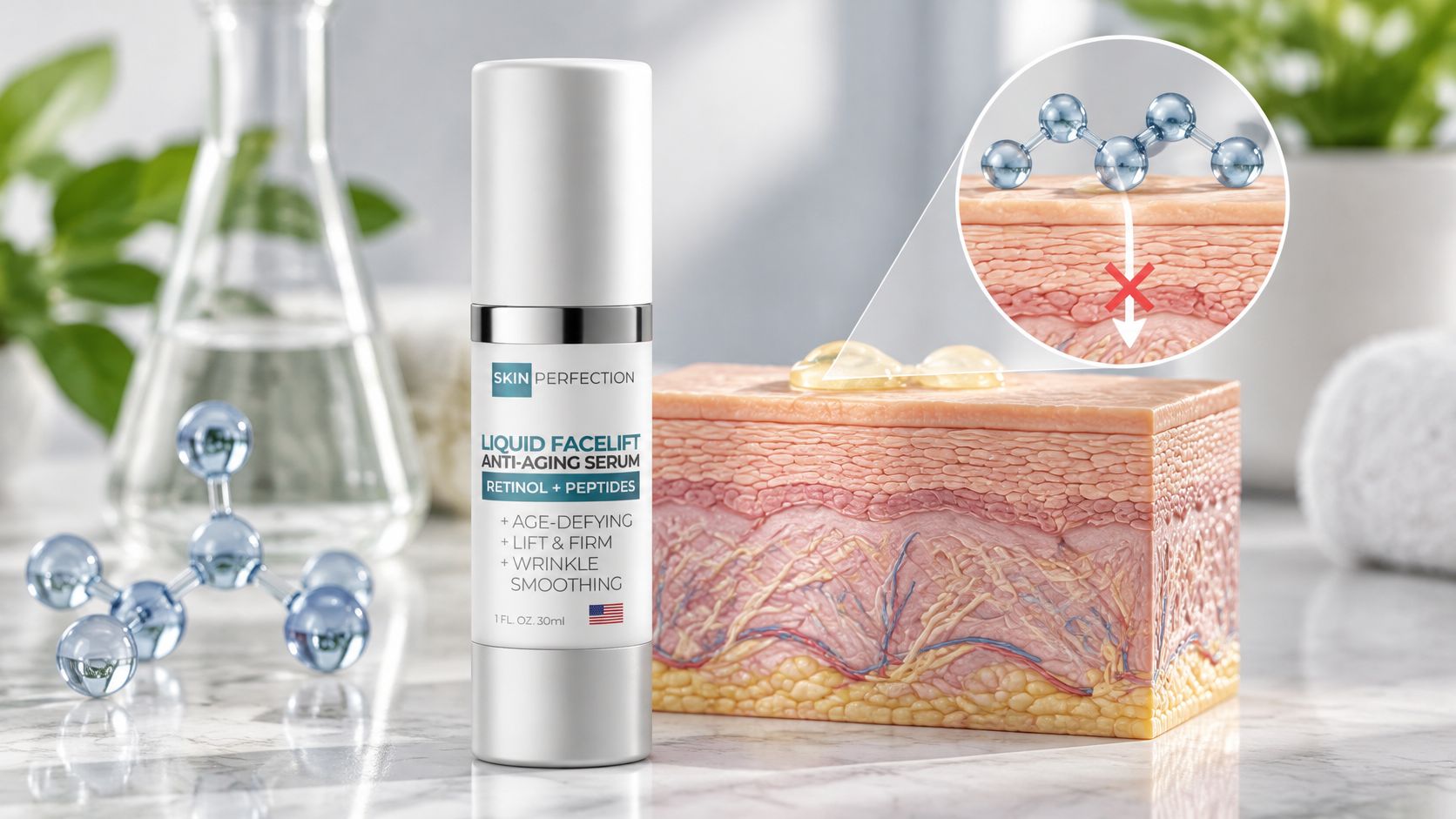
The first obstacle is the stratum corneum, the skin's outer barrier. Its tightly packed structure limits the passage of large, water-loving molecules, including native collagen. For a topical ingredient, being applied to skin and reaching deeper skin are separate outcomes.
Native collagen is too large for a conventional cream to carry it readily into the dermis, where fibroblasts synthesize structural collagen. A surface film is a more plausible outcome. That film may help limit water loss and temporarily smooth the skin, but neither effect establishes that collagen has crossed the barrier. A smoother surface cannot, by itself, reveal how far an ingredient traveled.
What smaller pieces do in animals
Hydrolyzed collagen consists of smaller fragments. Breaking down the protein changes its delivery possibilities, but molecular weight alone does not determine penetration. Shape, solubility, the surrounding vehicle, and skin condition also influence how much material passes through. The difference between peptides and proteins helps explain why intact collagen and hydrolyzed ingredients cannot be treated as interchangeable.
Smaller did not consistently mean better penetration in the animal experiment.
In a fish-scale collagen study published in 2010, fractions of 3,500 and 4,500 daltons showed greater cumulative penetration through nude-mouse skin than fractions of 1,300 and 2,000 daltons. The researchers tracked peptides from the stratum corneum toward the epidermis and dermis. This comparison makes a molecular-weight label less decisive than it might appear: the smallest fractions tested were not the best-performing fractions in that model.
The endpoint matters as much as the result. Tracking material through mouse skin measures delivery under the study's conditions. It does not measure visible wrinkle improvement in people, establish that the material becomes structural collagen, or demonstrate that a finished cream behaves the same way. Even hydrolyzed material can face substantial limits on passage through skin.
A penetration result in mouse skin is a delivery clue, not evidence of a visible change in a person's face.
For a finished product, stability and the base formula remain part of the delivery question. Human measurements of hydration, elasticity, and wrinkle depth address different outcomes, so they should not be treated as interchangeable evidence of deeper penetration.
Before accepting a deeper-delivery claim, check whether the molecular weight is disclosed and whether people were tested using the actual product. Then examine what was measured. Hydration can support a surface benefit; a claim about structural rebuilding requires evidence beyond smoother-looking skin or an ingredient's dalton number.
Topical Collagen Versus Your Skin's Own Collagen
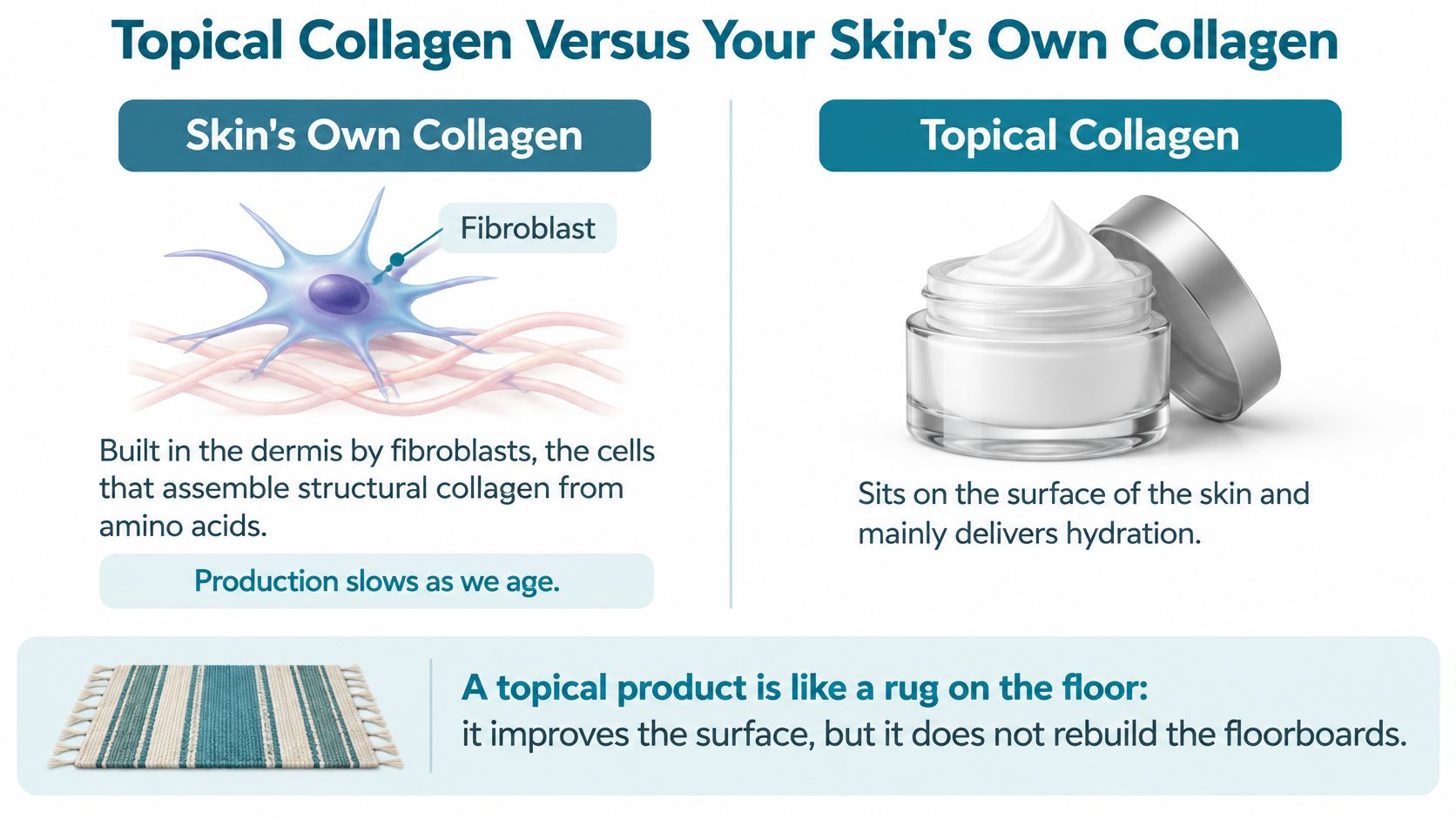
Your skin builds its own collagen in the dermis. Fibroblasts, the resident cells in that layer, assemble structural collagen from amino acids, and that output slows with age. Firmness changes even when a moisturizer still feels pleasant.
A collagen cream works at a different address. It sits on the stratum corneum, the outermost layer, where it can hold water against the surface and smooth how light reflects off skin. The cells responsible for structural support operate underneath, on a schedule measured in months. These are two separate jobs happening in two separate layers.
| Feature | Topical Collagen | Skin's Own Collagen Production |
|---|---|---|
| Where it acts | Outer layer, the stratum corneum | Dermis, built by fibroblasts |
| Molecule size | Large native collagen or smaller hydrolyzed peptides | Assembled inside cells from amino acids |
| Main visible effect | Surface hydration and smoothness | Gradual firmness and structural support |
| Time to notice a change | Days to weeks | Months |
| What controls the result | Formula, vehicle and molecular weight | Age, sun exposure, nutrition and cell activity |
Surface feel and deeper support are different jobs
The visible effects of a collagen cream cluster in the left column. Slip, softness, and a plumper look show up in days to weeks, because water and a surface film change the skin's appearance quickly. Structural support, the right column, runs slower. Firmness that comes from fibers built by fibroblasts takes months, and it is steered by age, sun exposure, nutrition, and how active those cells still are.
That split is why a phrase like "boosts collagen" is hard to interpret. It might mean the surface looks smoother. It might mean someone believes fibroblasts produced new collagen. Those claims require different evidence. Appearance can be judged with photographs and instruments on the skin you can touch. A change inside the dermis needs a study designed to measure that layer, not a softer feel after one week of use.
Ingredient names add a second layer of confusion. An explainer on methylsilanol hydroxyproline aspartate explained is useful here because the name resembles a collagen building block, yet a name tells you nothing about where the molecule sits after application. Humectants create a similar mix-up. A low molecular weight hyaluronic acid can change how hydrated the surface feels without being collagen at all.
A finished product such as Liquid Facelift Collagen Serum belongs to the same category of evidence: it is a topical formula, part of a line built around anti-aging peptides and botanical actives, aimed at the look of lines and firmness at the surface. If a label promises collagen production, ask which column that promise falls in. Surface hydration and a dermal change are different results, and they are proven by different kinds of tests.
What Human Studies Have Measured So Far
The most useful evidence comes from controlled human tests of the topical formula itself. Studies of swallowed collagen, cells, and mouse skin can help explain possible mechanisms, but they answer different questions. For a cream, the decisive issue is whether applying it produces a measured benefit beyond the comparison treatment, and what that measurement represents.
One relevant human design is a randomized, double-blind, placebo-controlled factorial trial of topical and oral hydrolyzed collagen in postmenopausal women with dermatoporosis. A factorial design helps separate the effects of applying collagen, swallowing it, and combining the treatments. Its relevance remains specific to the tested formulas and population. It cannot establish that every collagen cream works.
A separate controlled oral study involving 52 volunteers over 56 days reported changes in moisturization, elasticity, and wrinkle depth after 28 days, as described in the 2022 clinical paper. Those measurements concern an oral treatment, even though they appear in a paper discussing topical treatment too.
| Study | Participants | Duration | Measured outcomes and limits |
|---|---|---|---|
| Topical and oral hydrolyzed collagen factorial trial | Postmenopausal women with dermatoporosis | Treatment period not specified in the summary | Compares topical and oral treatment; the summary does not establish a structural rebuilding result |
| Oral hydrolyzed collagen controlled study | Human volunteers | Treatment period with an interim assessment | Moisturization, elasticity, and wrinkle depth following oral treatment |
| Oral bioactive collagen peptides trial | 77 women studied over 12 weeks, discussed in the 2025 systematic review and meta-analysis | 12-week treatment period | Hydration, water loss, and dermal density following oral treatment |
| Fish-scale peptide penetration study | Nude mice | Laboratory exposure rather than a human treatment course | Penetration into epidermis and dermis; no human cosmetic outcome established |
Why the other rows cannot prove a cream
Route of delivery changes the question.
Swallowed peptides undergo digestion and absorption before their components circulate through the body. Applied peptides encounter the skin barrier first. An oral trial can therefore support a conclusion about the supplement tested without establishing that the same material works when spread on skin.
The oral literature includes measured improvements in hydration and elasticity, as well as trials using specified daily doses of low-molecular-weight collagen. Those doses describe what participants swallowed. They provide no equivalent topical concentration and no evidence that a cream delivers the same exposure to deeper skin. Even a dermal measurement following supplementation cannot establish what happens after topical application.
The 2010 experimental report's later clinical context concerns experimental collagen-peptide research; its animal penetration findings should be read as evidence of movement through mouse skin, rather than a controlled human demonstration of wrinkle reduction or collagen rebuilding. Penetration is a delivery finding. A cosmetic benefit requires an outcome measurement, and a structural claim requires evidence about the tissue itself.
A 2026 review of topical collagen peptides describes limited topical clinical evidence and the need for well-designed randomized, double-blind, controlled trials, particularly for enhanced-delivery formulas. The practical distinction is between an observed improvement in skin condition and an inferred explanation for that improvement. Better hydration, elasticity measurements, or ultrasound echogenicity should not automatically be translated into newly formed collagen fibers.
For readers comparing peptide serum benefits, the useful question is which cosmetic endpoint a human study measured. Surface conditioning can be worthwhile without proving structural rebuilding. The evidence should determine how narrowly the benefit is described.
How to Read a Collagen Label Before You Buy
Two serums and a DIY bottle can all carry the word collagen while giving the buyer very different information. The useful read is a short checklist tied to what the label can support. Hydration, softness, and the look of lines are cosmetic endpoints. Claims about rebuilding deeper collagen need human evidence that the product has measured.
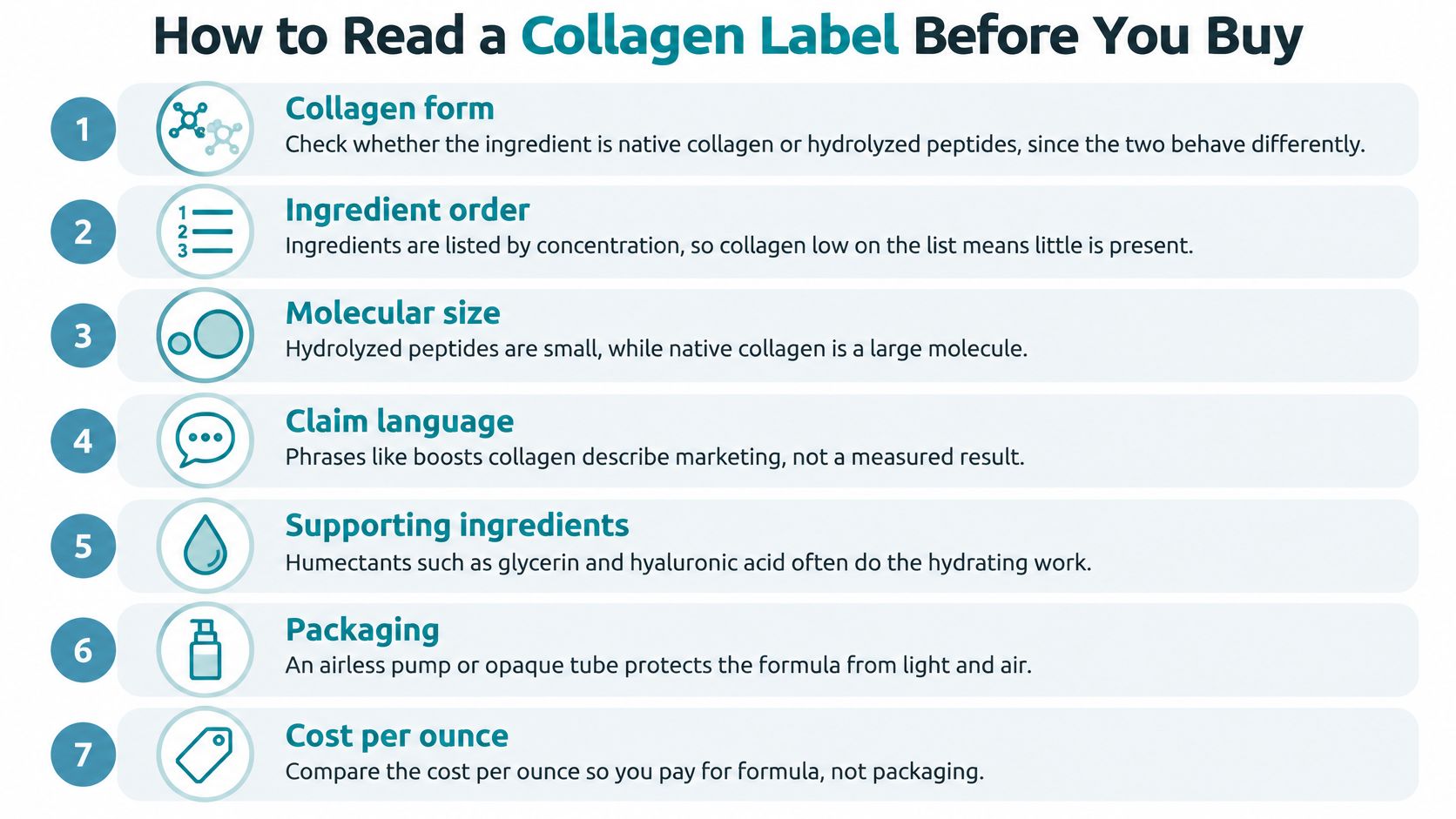
- Collagen form. Check whether the ingredient is native collagen or hydrolyzed peptides. A whole large protein and a cut fragment do not sit on skin in the same way.
- Molecular weight. Check whether a number is disclosed at all. In the animal fractions discussed earlier, 1,300 to 2,000 Da material penetrated less than 3,500 to 4,500 Da material, so size can matter more than the general word collagen.
- Concentration. Note the percentage. The moisture and elasticity change tied to a 10% fish-skin peptide formula shows what a concentration-specific result looks like. A formula that hides the level gives you nothing to compare.
- Vehicle and stability. The base has to carry the ingredient. Stability data matters because a peptide in a finished formula needs to remain useful during real use, not only when the ingredient is made.
- Delivery technology. Look for penetration data on the finished product. A system that worked in one lab formula does not automatically transfer to a different base.
- Study design. Look for a placebo-controlled human trial of the finished product lasting at least 8 to 12 weeks, with hydration, elasticity, or wrinkle depth measured. Shorter or uncontrolled tests answer smaller questions.
- Source and sensitivity. See whether the collagen is marine, bovine, or a vegan stand-in. Patch test before regular use if you have a fish, shellfish, or other known allergy.
What to flag, and what we look for instead
Flag any sentence that says a cream rebuilds deep dermal collagen. That claim remains unproven for standard topical collagen. Phrases about firmness, softness, and the look of lines can still be fair when they describe the surface. For the look of fine lines, the shopping list is Matrixyl 3000, Matrixyl Synthe-6, and peptide blends, which name specific peptides rather than relying on a generic collagen banner. The anti-aging ingredient terms guide is a plain glossary for those names, so a label is easier to parse.
An ingredient list can show what was added. It cannot show whether the finished formula changed water loss, surface feel, elasticity readings, or the appearance of lines. That distinction matters most when a product is mixed at home, because the final base and concentration are chosen by the maker. Liquid Collagen Serum Booster can be used as a booster in oil or water serums without heat, and it is positioned for surface hydration. Blending it into a base does not create a clinical trial of that base. Run the seven checks on the formula you put on your face: form, size if known, how much you added, the vehicle, any delivery data, any human test, and your own allergy history.
Realistic Timeline and Your Next Step
The first change, if one comes, is almost always feel. Within the first days, skin often seems more hydrated, and the surface texture feels softer. That pattern fits what the evidence supports: a film and water at the outer layer arrive before any slower shift in firmness, and they are the only effects the topical human record shows.
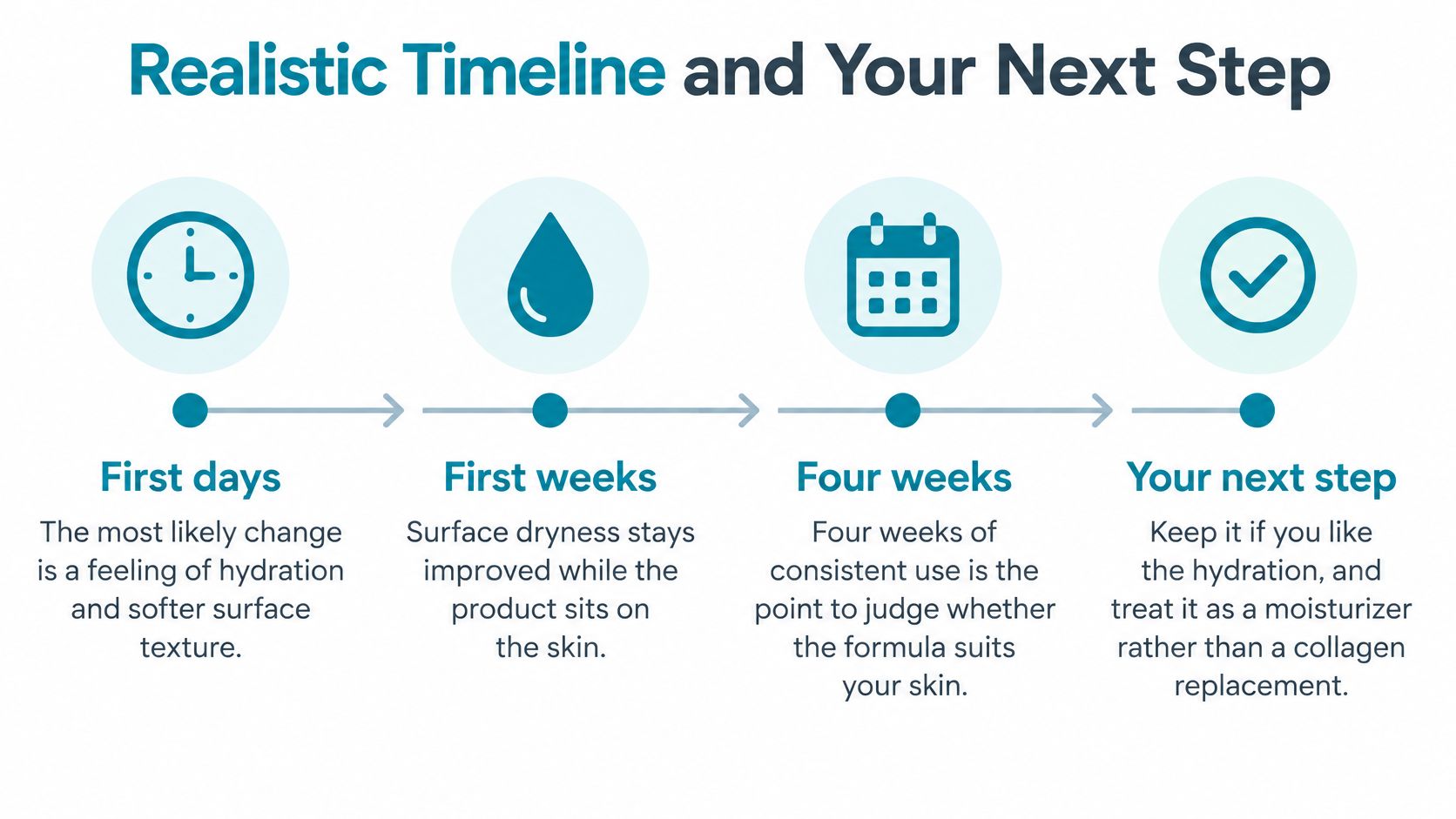
Use four weeks of consistent use as the minimum test. We advise that window because hydration shows up right away, while changes in lines and firmness take longer, so a shorter trial mostly measures the first evening. By one month you are also near the horizon of the topical human tests already on record. Judge comfort, dryness, and whether makeup or moisturizer sits better on the skin. Collagen formation sits outside what that calendar can show.
Past eight to twelve weeks, look again at firmness and the depth of lines, and keep the limit in view. Structural change, if a formula could produce it at all, would need more time, and the human file for standard creams stops at the surface. If nothing about the look of lines has shifted by then, a longer run of the same jar is unlikely to produce a different answer.
What changes after you stop
Because the supported topical effect is hydration and a surface film, expect that effect to fade once applications stop. The film lasts only as long as the product does. Swallowed peptides behave differently: the oral bioactive peptide trial covered earlier in this guide also tracked a four-week washout, and some measured benefits held through it, according to the human oral-peptide trial. That washout belongs to oral use. For a standard collagen cream, the evidence on record says nothing about a leftover result.
Treat the cream as a hydrating step you can pause and restart. Nothing on record promises a structural result that outlasts the jar.
For a decision you can make this week, place topical collagen in the routine as a hydrating step and set two review dates, one at four weeks and one between eight and twelve. Choose the product that passes the label checks over the jar with the largest collagen claim on the front. Habits that support your own collagen, including the approaches in our notes on natural ways to increase collagen, work alongside a cream on their own terms, while the cream's contribution stays what the trials measured.
If a concern sticks around, see a dermatologist. A cosmetic moisturizer is not a professional assessment. We also publish practical guides, including one on the look of dark circles and one on how to strengthen the skin barrier, for readers who want the surrounding routine without turning a jar into a medical promise.
Skin Perfection makes natural skin care and lotion-making supplies for people who want the look of softer, more hydrated skin without overstated collagen claims. If you are comparing a collagen cream, a peptide serum, or a DIY booster, start with the evidence limits in this guide, then browse formulas and supplies at Skin Perfection. Bring the label checklist with you so the product you pick matches the result the trials measured.