

 Buy with Prime


Murumuru butter contains about 40% to 50% lauric acid, a fatty acid level that helps explain why this Amazonian butter feels so different from familiar choices such as shea and cocoa. It stays firm on a countertop, then melts quickly across warm skin, leaving a smooth, glossy layer instead of the dense drag many people associate with heavier plant butters. Published ingredient information connects this composition with its use in moisturizers, conditioners, and balms.
That chemistry makes murumuru butter useful for more than adding richness to a formula. It can improve slip, soften the feel of dry areas, add shine to hair, and help a product hold moisture at the surface. The important distinction is that these are cosmetic benefits, not therapeutic effects. Murumuru is a plant-derived emollient for skin and hair products, not a treatment for a medical condition.
Table of Contents
- What Murumuru Butter Is and Where It Comes From
- The Fatty Acid and Phytosterol Profile Explained
- Skin and Hair Benefits You Can Observe
- How Murumuru Compares to Shea, Cocoa, and Kokum Butter
- Recommended Usage Rates and DIY Recipe Ideas
- Sourcing, Sustainability, and Cosmetic Safety
- Common Misconceptions and Contraindications
- Putting Murumuru Butter to Work in Your Routine
What Murumuru Butter Is and Where It Comes From
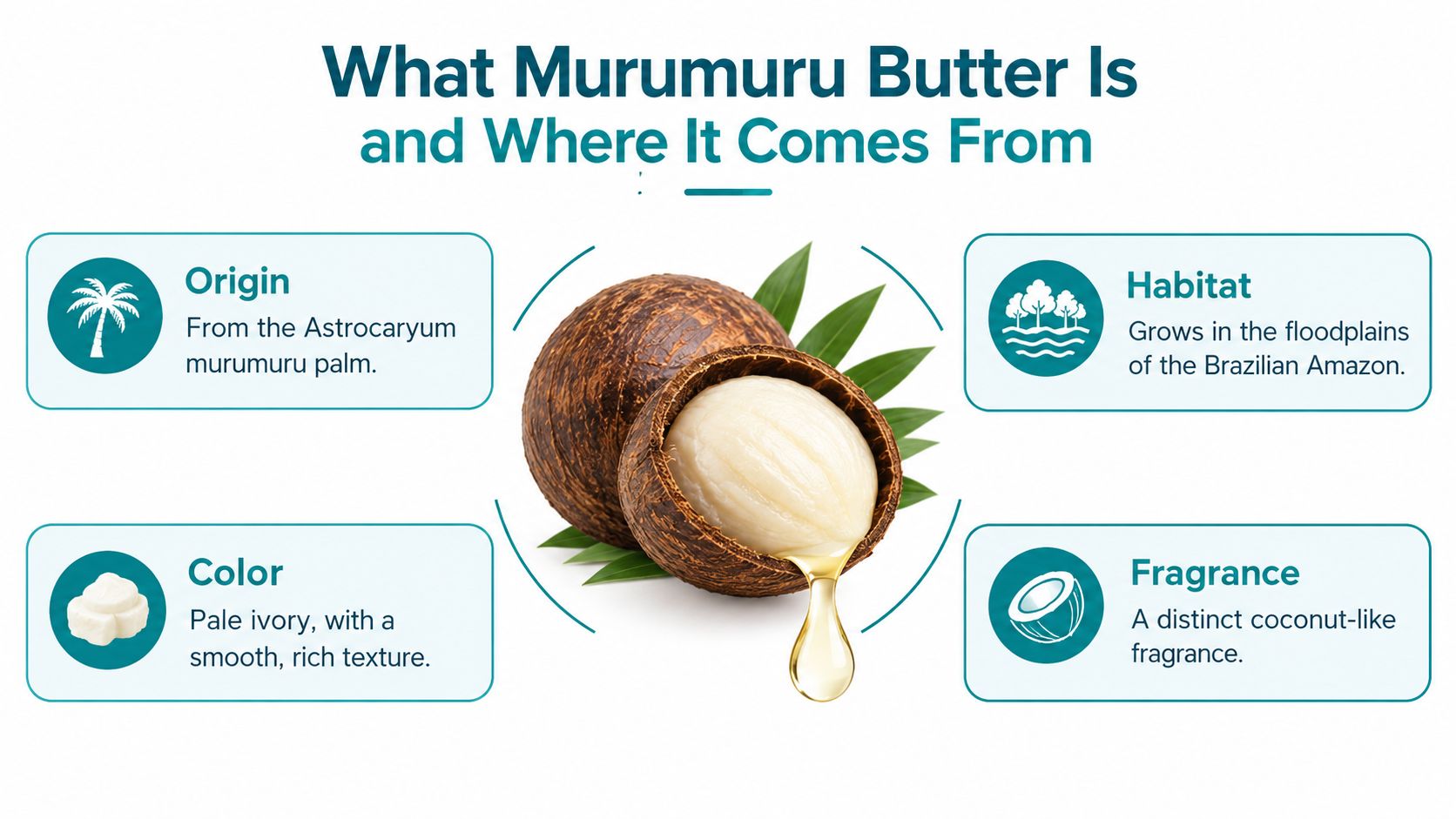
Murumuru butter melts at around 33°C, a temperature that helps explain its distinctive behavior in topical formulas. It is a pale, fragrant plant fat pressed from the seeds of the Astrocaryum murumuru palm, which grows in floodplain areas of the Brazilian Amazon. The seeds become an ingredient for lotions, creams, soaps, shampoos, conditioners, masks, oils, emulsions, and moisturizers. An ingredient specification sheet identifies it as a skin-conditioning emollient used across skin and hair formulations.
That relatively low melting point creates a useful sensory sequence. The butter can remain firm at room temperature, then soften quickly when warmed between the fingers or spread over skin. The reported physical and fatty-acid profile helps connect its physical form with its easy spread.
The practical identity of the butter
Murumuru works as a structuring butter with a quick sensory payoff. It gives a balm or cream body while spreading more readily than a dense, waxy-feeling butter. Its strong lauric and myristic presence helps explain why formulators may choose it when they want firmness, glide, and a comfortable finish in the same ingredient.
That chemistry gives DIY makers a practical way to assess it. A formula containing murumuru should feel structured in the jar but become easier to distribute with body warmth. Compare it with shea or cocoa by checking three things: how quickly it softens, how much drag remains after application, and whether the final product feels coated or smooth. Broader botanical sourcing context is available in this guide to farm-to-face skincare.
On skin, murumuru can support softness and a comfortable surface film. In hair products, it can contribute conditioning and slip. Those are cosmetic effects. The butter does not fix, repair, or heal a medical skin or hair condition.
The Fatty Acid and Phytosterol Profile Explained
About 70% of murumuru butter's total mass may come from lauric acid and myristic acid combined. That finding, reported in The published analysis, helps explain why murumuru behaves differently from shea or cocoa butter. Its fatty-acid profile gives it a firm structure that softens and spreads readily with body warmth.
Results vary between technical references because growing conditions, processing, and testing methods influence the measured composition. The main pattern remains clear: lauric acid is the largest fraction, myristic acid follows, and oleic acid is present in a smaller amount. A technical specification for virgin murumuru butter reports approximately 44% to 60% lauric acid, 24% to 32% myristic acid, and about 90% total saturated fatty acids.
| Fatty Acid | Carbon Chain | Typical % Range | Functional Note |
|---|---|---|---|
| Lauric acid | C12:0 | About 40% to 50% | Supports quick spread, glide, and a firm structure that melts readily |
| Myristic acid | C14:0 | About 24% to 33% | Adds slip, body, and a smooth emollient finish |
| Oleic acid | C18:1 | About 7% to 13% | Contributes conditioning and softness without dominating the profile |
| Other fatty acids | Various | Smaller fractions | Refine the texture and overall sensory character |
Why the numbers matter to your hands
Fatty-acid chain length and saturation influence how a butter feels in the jar and on the skin. Murumuru's lauric and myristic acids help form a solid butter, yet that structure gives way fairly quickly under skin warmth. The result is similar to a firm balm with a short melting window: it holds its shape during storage, then becomes easier to distribute during application.
The high saturated fraction also makes murumuru more resistant to oxidation than many highly unsaturated botanical oils. That quality can help a natural formula retain its consistency during storage, although the complete recipe and packaging still affect product stability.
Murumuru contains plant sterols, including beta-sitosterol and stigmasterol, plus other minor lipid components found in botanical fats. Phytosterols can support a comfortable skin feel because their lipid-like character fits with the surface environment of skin. They do not make murumuru a medical active. Their contribution is better understood as part of the butter's conditioned, less dry-feeling finish.
This chemistry gives formulators a practical comparison tool. Against shea or cocoa butter, check how quickly each butter softens, how much drag remains during application, and whether the finished product feels coated or smooth. Murumuru often suits formulas that need firmness and glide together.
A facial product may use a different combination of emollients for a different sensory goal. HydroGlow Anti-Aging Night Mask includes hyaluronic acid, polyglutamic acid, jojoba, squalane, aloe, glycerin, and triglycerides for its overnight texture and moisture-focused experience. Murumuru would add mainly richness, glide, and a soft protective feel. For ideas on pairing emollients, consult this guide to carrier oils for skin.
Skin and Hair Benefits You Can Observe
Murumuru's useful benefits show up in the way a formula spreads, settles, and leaves skin or hair feeling. Its lauric and myristic emphasis helps explain that behavior. These fatty acids give the butter a quicker melt and cleaner slip than many heavier plant butters, so it can soften a formula without making every product feel waxy or dense.
On skin
Murumuru creates an emollient film across the skin. In practical terms, it fills some of the tiny uneven spaces that make dry skin feel rough, much like smoothing a wrinkled fabric surface. A body butter can therefore feel less powdery and tight, while a balm can glide over dry patches instead of catching on them.
The butter also slows moisture loss from the skin's surface through an occlusive effect. It does not add water by itself. Instead, it helps hold onto comfort supplied by the water phase or by other humectants. As noted earlier, its film-forming behavior is associated with reduced transepidermal water loss, but the result still depends on the formula's overall balance and the amount used.
The final finish is often smooth and polished rather than sharply greasy. A high-butter balm will remain rich because the whole formula is concentrated. A lotion containing a modest amount can gain spreadability and softness without feeling as heavy.
Practical rule: Choose murumuru for the finish you want, not simply because a formula contains a butter. The same ingredient can feel light and silky in a lotion, yet substantial in an anhydrous balm.
On hair
Hair responds to murumuru through a similar surface effect, with the cuticle taking the place of the skin's outer layer. The butter coats and lubricates the fiber, helping strands slide past one another. That can reduce a rough feel, calm flyaways, improve combing, and give hair a soft gloss.
The effect is most noticeable in very dry, damaged, or chemically treated hair, where raised or uneven cuticles can create drag. A pre-shampoo treatment, conditioner, leave-in cream, or mask may use murumuru to improve slip during detangling. It conditions the surface, though it does not rebuild the inside of a hair strand or treat a scalp or hair disorder.
A useful formulation analogy is a two-part maintenance routine. A water-binding ingredient helps keep moisture available, while a lipid emollient helps reduce friction and slow surface moisture loss. Sodium Hyaluronate Powder Pure Hyaluronic Acid suits water-based serums, creams, and lotions. Murumuru belongs in the oil phase or anhydrous phase. For a comparison with a richer, more cushioning butter in hair products, this guide to shea butter for hair provides a useful reference point.
How Murumuru Compares to Shea, Cocoa, and Kokum Butter
Plant butters aren't interchangeable just because they all arrive as solid fats. Their melting behavior, dominant fatty acids, aroma, and after-feel can change the result of a formula. Murumuru's lauric and myristic emphasis gives it a quicker melt and glossier slip than the heavier, longer-chain profile commonly associated with shea and cocoa.
The comparison below uses the practical distinctions most useful to a DIY formulator. Murumuru's melting point is reported around 33°C, while the other butter ranges shown here should be treated as formulation reference points rather than universal specifications, since grades and processing can vary.
| Butter | Melt Point (°C) | Dominant Fatty Acid | Skin Finish | Best Use |
|---|---|---|---|---|
| Murumuru | About 30 to 33 | Lauric and myristic | Fast-melting, glossy, smooth | Lotions, conditioners, balms needing slip |
| Shea | About 32 to 38 | Stearic and oleic | Rich, cushioning, more substantial | Body creams and richer moisturizers |
| Cocoa | About 30 to 35 | Stearic and oleic | Firm, protective, often more noticeable | Solid balms and structured body products |
| Kokum | About 35 to 40 | Stearic | Harder, drier, less glossy | Bars and formulas needing firmness |
The practical decision is straightforward. Choose murumuru when a formula needs fast melting and easy spread, shea when it needs a fuller cushion, cocoa when firmness and a recognizable aroma suit the product, and kokum when structure matters more than immediate glide. A hair product comparison such as Healtsy's Klorane product featuring mango butter can also help readers see how different botanical butters are selected for conditioning texture.
Don't substitute one butter gram for gram without checking the result. A swap can change hardness, cooling sensation, gloss, scent, and the amount of oil needed to reach the same consistency. Chemistry gives you a better substitution guide than popularity does.
Recommended Usage Rates and DIY Recipe Ideas
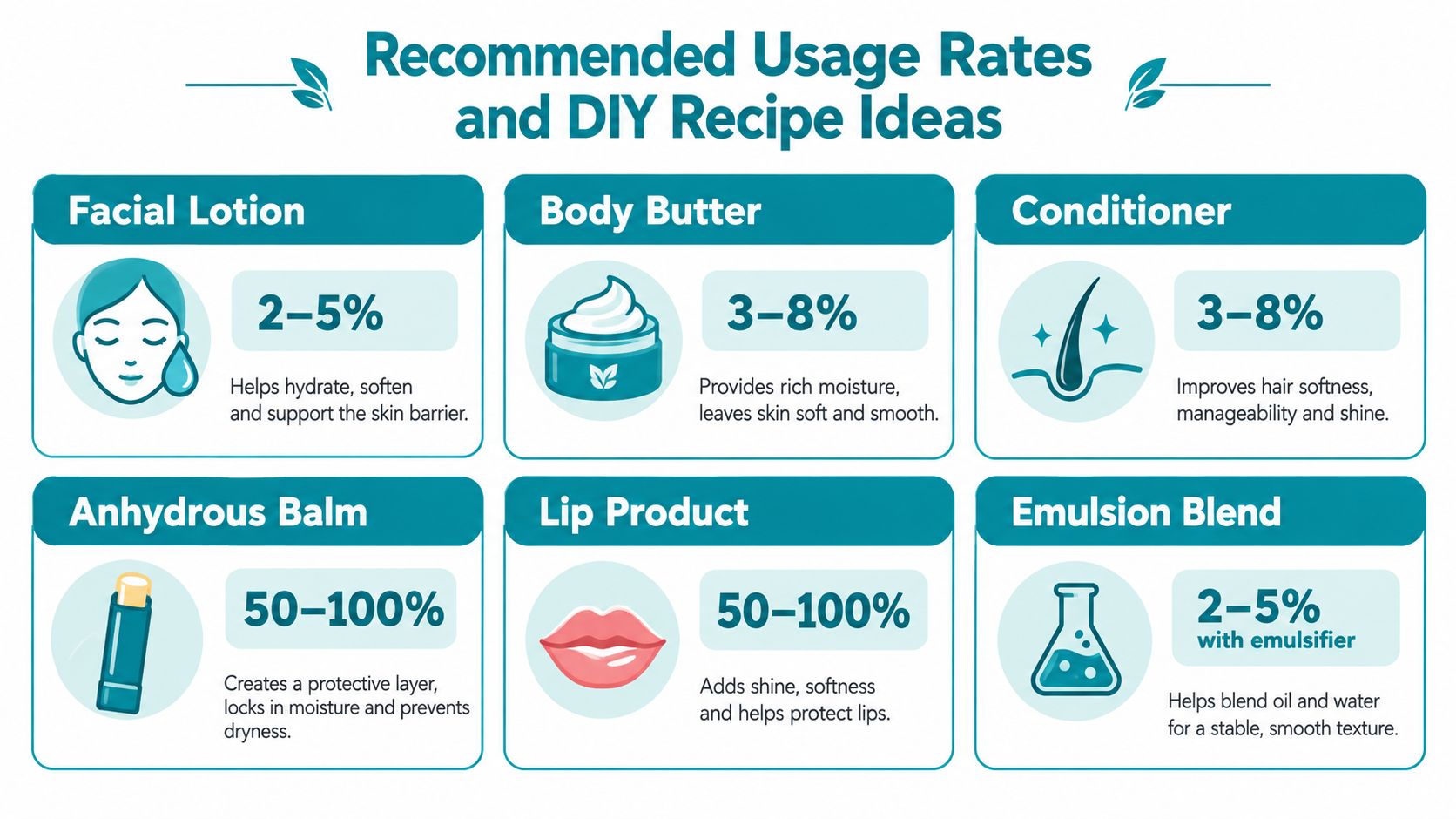
Usage level determines whether murumuru feels like a subtle texture enhancer or the main character in the formula. For a facial lotion, a practical starting range is 2% to 5%. Body butters and conditioners can use 3% to 8%, while anhydrous balms and lip products can contain 50% to 100% when the formula is designed around the butter.
Water-containing emulsions usually need more restraint. The butter has to work alongside the emulsifier and the rest of the oil phase, and too much can create a waxier drag or make the texture harder to balance. An anhydrous system has no water phase, so it can accommodate a much larger proportion of murumuru without an emulsion interface to manage.
A lightweight body butter starting point
For a small test batch, try a texture built around:
- 30% murumuru butter, for fast melt and glide.
- 20% shea butter, for a rounder, richer cushion.
- Lightweight liquid oils, making up most of the remaining oil phase.
- A small amount of tapioca starch, to reduce the oily after-feel.
Melt the butters and oils gently, then remove the container from heat before the mixture becomes excessively hot. Cool it while stirring, and allow it to thicken before whipping if a lighter texture is desired. The body butter making guide can provide additional context for working with anhydrous textures.
A conditioning hair mask
A conditioning mask can use 5% murumuru butter alongside 5% BTMS, cetrimonium chloride, a humectant phase, water, and the remaining ingredients required for a complete emulsified formula. BTMS and cetrimonium chloride provide the conditioning framework, while murumuru adds softness, slip, and a more polished finish to the hair fiber.
Keep the process controlled. Melt murumuru gently, preferably below 70°C, then cool the batch with steady mixing. Tempering the butter as it cools helps preserve a more consistent crystalline structure, which can reduce graininess and improve the final texture. Always calculate the complete formula to 100%, use suitable preservation for water-containing products, and test the finished product before regular use.
Sourcing, Sustainability, and Cosmetic Safety
Murumuru begins with the seeds of an Amazonian palm and ends as a refined or unrefined cosmetic butter. That supply chain matters because buyers increasingly want to know whether botanical ingredients support local livelihoods, protect forest resources, and come from traceable sources. A responsible supplier should be able to explain the ingredient's origin, processing method, and grade.
Look for documentation rather than relying on broad marketing language. Useful questions include:
- Origin: Can the supplier identify the Brazilian region or source community?
- Traceability: Is the path from seed collection to finished butter documented?
- Production method: Is the butter cold-pressed, refined, or processed in another way?
- Supplier standards: Does the company provide relevant fair-trade, rainforest, or single-origin documentation where applicable?
Murumuru is a seed butter from an Amazonian palm, but it isn't the same thing as palm oil. Buyers who avoid conventional palm-derived materials should still check the full supply chain and the supplier's written specification rather than assuming that “palm” and “palm oil” describe identical ingredients. Guidance on regenerative organic certification and brand standards can help put sourcing claims into a wider context.
What safety information tells formulators
The Cosmetic Ingredient Review panel concluded that Astrocaryum murumuru seed butter and sodium astrocaryum murumuruate are safe for use in cosmetics and personal care products. The CIR summary and ingredient information provide that safety conclusion and list a representative fatty-acid profile.
Safety data sheets describe murumuru butter as not expected to irritate skin, and one supplier document says it isn't expected to cause skin sensitization. The supplier safety data sheet supports its broad cosmetic use, but every finished formula still needs its own evaluation. Refined butter generally has a lighter color and less pronounced scent, while unrefined butter may retain more of its natural aroma and color. Specify the grade when ordering so batches behave consistently.
Common Misconceptions and Contraindications
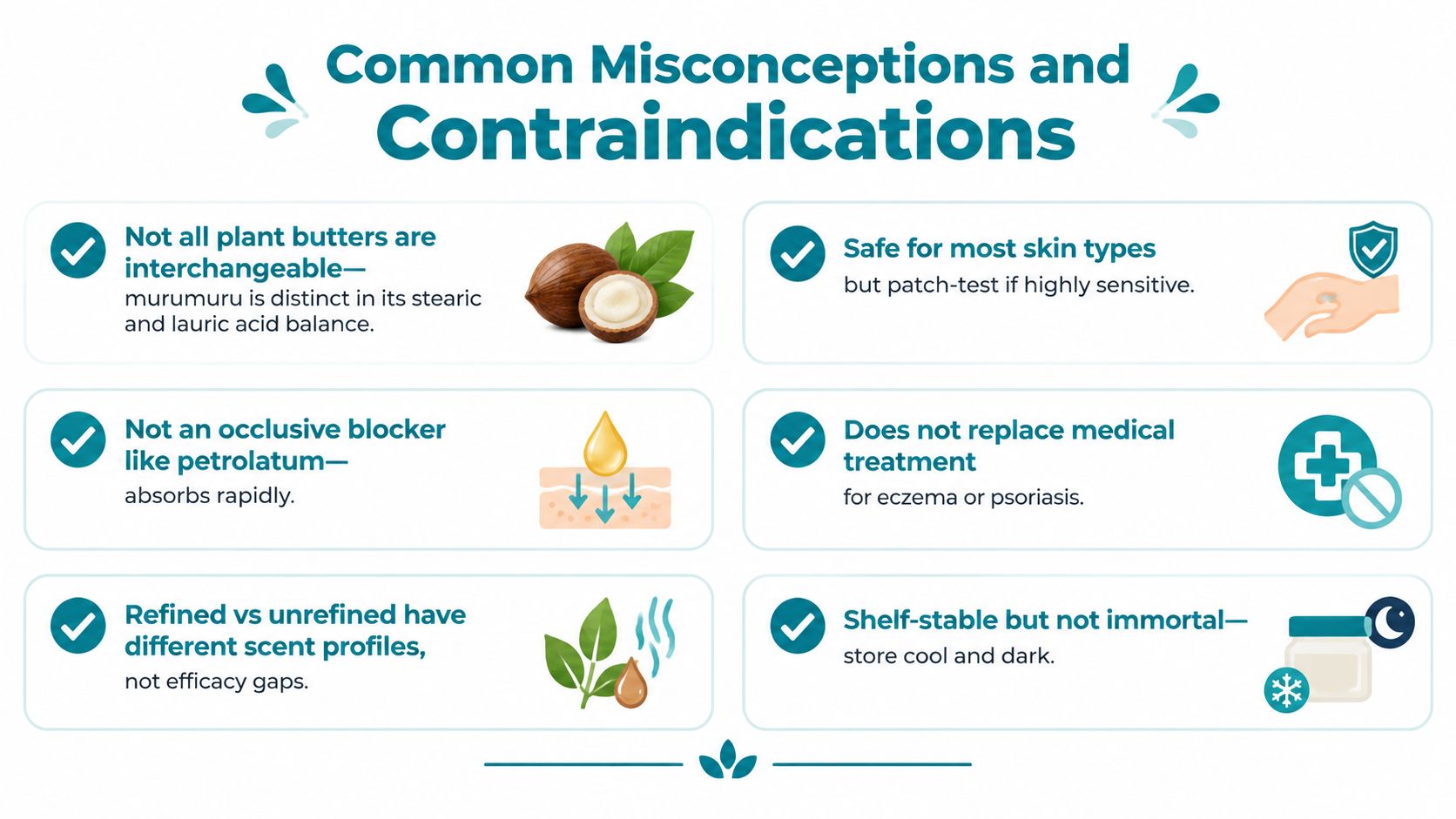
The first misconception is that every plant butter behaves the same. Shea, cocoa, kokum, and murumuru can all add richness, but their fatty-acid patterns create different melting curves and finishes. Murumuru's lauric and myristic dominance is the reason it can feel firm in the jar yet spread quickly on warm skin.
The second misconception is that “natural” automatically means hypoallergenic or non-comedogenic. Botanical origin doesn't remove the possibility of sensitivity, and a comedogenicity result can change with the formula, concentration, application area, and the rest of the ingredients. A supplier-backed test on an emulsion containing 5% murumuru butter reported no comedogenic effect, but that result shouldn't be treated as a guarantee for every product or every person. The formulation evaluation is useful evidence, not a universal promise.
Sensitivity and storage deserve attention
Murumuru comes from the Arecaceae palm family. Anyone with a known tree-nut, coconut, palm, or palm-kernel sensitivity should be especially cautious and discuss topical ingredient choices with a qualified healthcare professional. A patch test is sensible even when an ingredient has a favorable general safety profile.
Apply a small amount of the finished product to a limited area of clean skin, then observe how it feels over the next day. Don't test several new products at once, and stop using the product if you experience discomfort, redness, itching, or another unexpected response. Cosmetic murumuru butter also isn't automatically food-grade, and old, rancid, or poorly stored material can develop an unpleasant odor and may feel irritating.
Store the butter and finished anhydrous products in a cool, dark place with the container closed. Keep water out of the jar, use clean utensils, and discard material that has a changed smell, color, or texture.
Putting Murumuru Butter to Work in Your Routine
Murumuru earns its place when you want quick melt, glossy slip, surface softness, and a comfortable moisture-retaining film. Use a modest amount in an emulsion when you want the butter's sensory effect without making the product dense. Reserve higher levels for anhydrous balms, lip products, and body formulas designed to showcase its structure.
A simple decision guide looks like this:
- For facial lotions, begin with a low level and assess spread, absorption, and shine.
- For body products, combine murumuru with shea when you want both quick glide and richer cushion.
- For hair conditioners, pair it with a proper conditioning system rather than using the butter alone.
- For balms, increase the level gradually until the hardness and payoff feel right.
Small test batches reveal more than a supplier description. Make 50- to 100-gram batches, record the butter grade, heating temperature, cooling method, scent, hardness, and after-feel, then adjust one variable at a time. Store finished products cool and dark, and aim to use them within six to twelve months, while following the shelf-life guidance appropriate to the complete formula.
The best murumuru butter benefits appear when you treat the ingredient as a formulation tool rather than a miracle material. Test it beside shea, cocoa, or a lightweight oil, change the percentage carefully, and let the finished texture guide your next blend.
Skin Perfection offers skincare products and lotion-making supplies for readers who want ready-made cosmetic formulas or ingredients for their own projects. Visit Skin Perfection to explore plant-derived skincare options and supplies for testing murumuru butter in lotions, balms, and conditioning formulas.