

 Buy with Prime


The most popular advice about peptide skincare is also the least useful: “Just buy a serum with peptides.” That shortcut ignores the questions that determine whether a product makes sense for you. Which peptide is included? In what format? With which supporting ingredients? And does the label reveal enough to judge the formula?
Peptides appear in serums, moisturizers, eye creams, masks, lip products, and products used around the hairline. They're no longer limited to specialist anti-wrinkle formulas. This guide takes a formulator's approach to what skincare products have peptides, so you can evaluate the bottle in front of you instead of buying based on a large word on the front label.
Table of Contents
- Why Peptides Are Suddenly in Everything
- What Peptides Actually Are in Skincare
- The Four Peptide Families and How They Work
- Product Formats That Carry Peptides
- Reading Peptide Names on an Ingredient List
- Matching Peptide Products to Your Skin Type
- Common Misconceptions About Peptide Skincare
- A Simple Checklist for Choosing Peptide Products
Why Peptides Are Suddenly in Everything
In 2026, peptide claims are difficult to miss. Serums, moisturizers, eye products, and newer lip and hair-adjacent formats all use the ingredient category to suggest firmness, smoothness, or better-looking skin. Yet many shoppers still can't explain what a peptide does, how it differs from a retinoid, or why one peptide cream may be more suitable than another.
Interest is broadening beyond traditional anti-aging products. Recent market coverage cited peptide therapy interest rising 281% on Google and 459% on TikTok year over year, although those figures describe search and social interest rather than proof that topical products deliver a particular result. Cosmetics Business coverage of peptide trends also points to peptide use spreading into lip care, hair repair, SPF color cosmetics, and body-adjacent categories.
The ingredient class has a longer history than the current trend suggests. Peptides entered skincare conversations in 1973, when Pickart identified the synthetic signal peptide GHK, and cosmetic use later expanded through ingredients such as copper glycine-histidine-lysine and palmitoyl pentapeptide-4. This peer-reviewed historical review places today's popularity in that broader development rather than treating peptides as a brand-new discovery.
Why shoppers see them everywhere
A second reason is positioning. Brands often present peptides as a gentler choice for shoppers who want visible aging support without building a routine around more aggressive-feeling actives. Dermatology and beauty coverage has also placed greater attention on barrier-supportive routines and tolerability, which gives peptides more visibility among people with dry or easily uncomfortable skin. Vogue's 2026 skincare trend coverage describes this move toward barrier-focused care.
That positioning shouldn't turn into a promise. A peptide's proposed mechanism can be interesting while the finished formula delivers only a modest visible change. The useful skill isn't memorizing every product name. It's learning to compare format, peptide family, label position, packaging, and supporting ingredients before you buy.
What Peptides Actually Are in Skincare
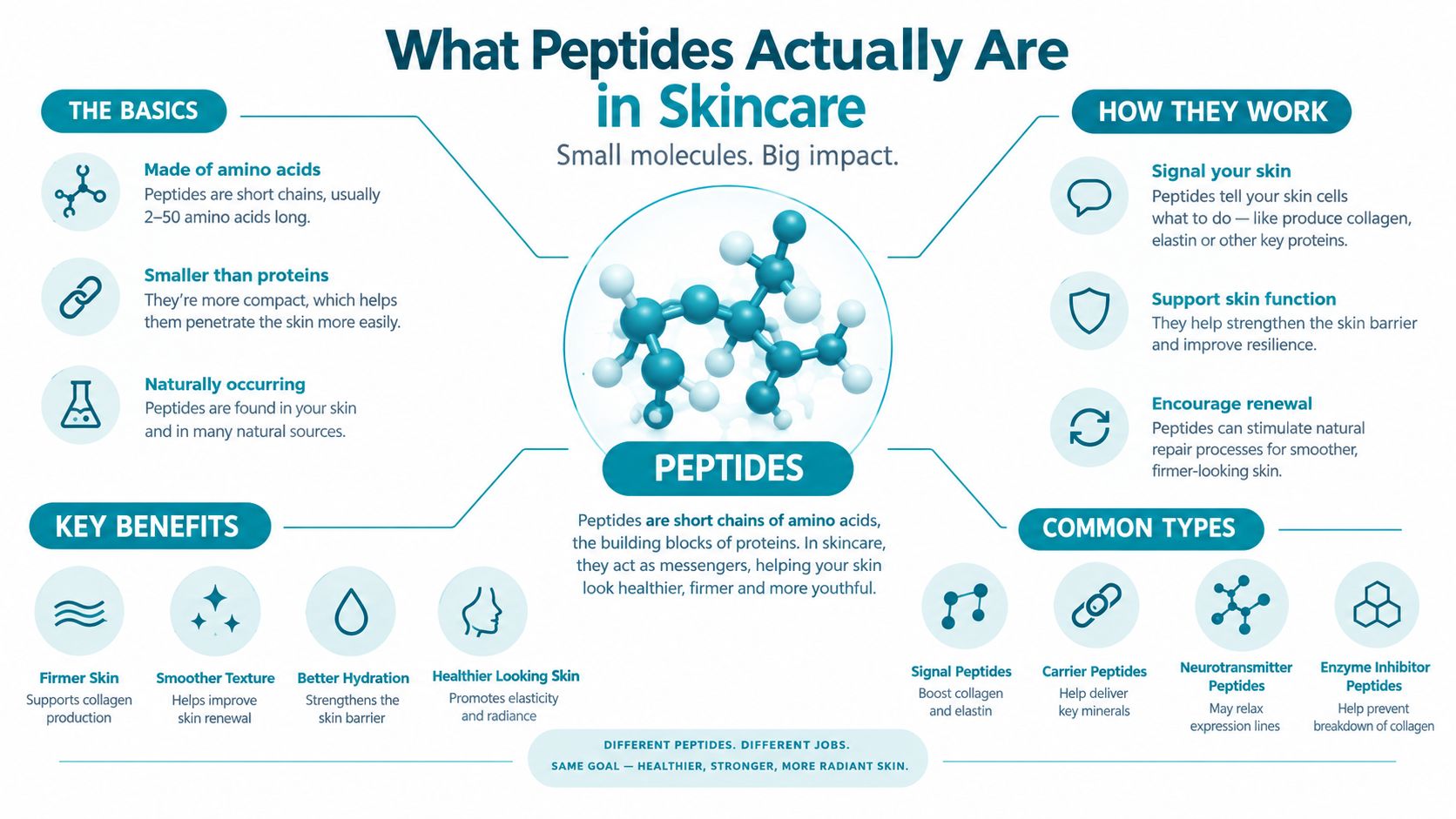
Think of a peptide as a short word built from amino-acid letters. A peptide contains two to fifty amino acids, according to this ingredient overview from Dermalogica. A protein is a much larger structure, while a peptide is a smaller chain whose sequence can influence how it behaves in a cosmetic formula.
That sequence matters. Change the order or the attached group and you change the molecule's identity, stability, and intended cosmetic role. A formulator might use a peptide to support the appearance of firmness, while another is selected for its relationship with expression lines or for its ability to carry a trace element. The name on the ingredient list often gives you clues, but it doesn't tell you the whole formula story.
Cosmetic peptides may be synthetic, biofermented, or derived from natural materials. Shorter chains can be easier to work with in targeted cosmetic formulations, but “small” doesn't automatically mean that a peptide will pass deeply into skin or produce a dramatic result. Vehicle, pH, packaging, preservation, solubility, and the peptide's actual use level all matter.
For a more specialized explanation of bioactive peptide terminology, this guide to bioactive peptides is a useful companion. The practical point is simple: a peptide is a functional ingredient category, not a guarantee of performance.
From molecule to cosmetic purpose
Large proteins such as collagen and elastin are not interchangeable with the short peptides placed into a cream. Topical cosmetic peptides are generally selected to interact with the skin environment in a particular way, while the complete formula also determines how long the ingredient remains in contact with the surface.
A useful mental model is a message in a bottle. The peptide may carry a signal, a mineral, or an inhibitory function, but the finished product determines whether that message is delivered consistently enough to matter cosmetically.
The Four Peptide Families and How They Work
A peer-reviewed review in PubMed Central's cosmetic peptide literature groups cosmetic peptides by proposed mechanism. The four broad families are signal peptides, neurotransmitter-inhibitor peptides, carrier peptides, and enzyme-inhibitor peptides.
Signal peptides are the easiest place to start. Ingredients such as palmitoyl pentapeptide-4 and palmitoyl tripeptide-1 are associated with signaling intended to encourage fibroblast activity and support the appearance of collagen-related firmness. Neurotransmitter-inhibitor peptides, including acetyl hexapeptide-8, are formulated around the appearance of expression lines by influencing signals associated with facial muscle contraction. Their topical action isn't equivalent to an injectable procedure.
Carrier peptides take a different route. Copper tripeptide-1 is the familiar example, designed to bind or shuttle a trace element within a cosmetic system. Enzyme-inhibitor peptides are intended to slow processes associated with the breakdown of structural proteins. These categories can overlap in real formulas, and a label doesn't always tell you which mechanism is dominant.
| Peptide Family | How It Works | Example Ingredients | Common Skin Goal |
|---|---|---|---|
| Signal peptides | Communicate with skin cells and support collagen-related signaling | Palmitoyl pentapeptide-4, palmitoyl tripeptide-1 | Firmer-looking skin and softer-looking fine lines |
| Neurotransmitter-inhibitor peptides | Influence signals associated with expression-related muscle contraction | Acetyl hexapeptide-8 | Smoother-looking expression lines |
| Carrier peptides | Carry or bind trace elements used in cosmetic processes | Copper tripeptide-1 | Support for the appearance of firmness and skin quality |
| Enzyme-inhibitor peptides | Help limit activity linked with structural-protein breakdown | Ingredient names vary by peptide | Maintaining the appearance of firmness |
Peptides are not the same as every active beside them
A formula can contain a peptide and still rely heavily on humectants, emollients, or barrier-support ingredients for its immediate sensory effect. For example, Sodium Hyaluronate Powder Pure Hyaluronic Acid is a cosmetic-grade hyaluronic acid ingredient, not a peptide. Its stated NASHA high-molecular-weight grade has a molecular weight of 800–1500 Daltons, and the product can be used to make water-based serums, creams, and lotions at stated DIY serum concentrations of 0.1–2%.
That distinction matters when reading marketing. Hyaluronic acid can contribute to a hydrated, plumper-looking surface, while a peptide may be included for signaling or another defined cosmetic function. One doesn't become the other just because both appear in a hydrating serum. For further terminology, this overview of next-generation peptides can help you compare emerging ingredient language without treating every new name as a separate miracle category.
Product Formats That Carry Peptides
The answer to “what skincare products have peptides” includes far more than a face serum. Format changes contact time, texture, layering, and the kind of supporting ingredients a formulator can include. It doesn't automatically change the peptide itself.
A serum usually gives you a light, low-residue vehicle that layers easily under moisturizer. A cream can combine peptides with emollients and occlusive ingredients, making it more comfortable for dry skin and reducing the need for several separate steps. An eye cream uses a product texture designed for the eye area, but the presence of a peptide doesn't make the product suitable for direct contact with the eyes.
Masks create either a short wash-off exposure or a longer leave-on experience, depending on the product. Lip balms and lip treatments place the formula on the lips and lip border, where shoppers often focus on the look of dryness or fine lines. Hair-adjacent leave-on products may be applied to scalp skin or around the hairline, but peptide density and product purpose vary considerably between formulas.
| Format | Vehicle Type | Contact Time | Best For |
|---|---|---|---|
| Serum | Lightweight water-based or gel formula | Leave-on, usually layered | Targeted peptide use with minimal residue |
| Moisturizer | Emulsion with emollients and occlusive ingredients | Leave-on throughout the day or night | Daily maintenance and comfortable layering |
| Eye cream | Lightweight or cushioning emulsion | Leave-on around the orbital area | A dedicated texture for the eye area |
| Mask | Sheet, gel, cream, or overnight emulsion | Short exposure or overnight | A concentrated-feeling routine step |
| Lip product | Balm, oil, or treatment base | Repeated local application | Lip comfort and the look of the lip border |
| Hair-adjacent leave-on | Mist, serum, lotion, or gel | Leave-on on scalp skin or hairline | Cosmetic care around hair-adjacent areas |
A product gallery such as Image products from Spa Black can help shoppers compare how brands present different formats visually, but packaging photography won't reveal peptide concentration. Use it to identify format, then return to the ingredient list.
How to choose between a serum and a cream
Choose a serum when you want a focused layer under other products and prefer a lighter finish. Choose a moisturizer when daily comfort and fewer routine steps matter more. This comparison of serums and moisturizers is useful because a peptide serum and a peptide moisturizer can contain similar families while behaving very differently on the skin.
A mask can be enjoyable, but it shouldn't be your only source of a peptide if you want a consistent routine. Leave-on formats usually make more sense for regular use, provided the formula suits your skin and you apply it as directed.
Reading Peptide Names on an Ingredient List
Start by scanning for recognizable peptide stems rather than the word “peptide” on the front label. Palmitoyl, acetyl, and copper can indicate an attached group or complex, while tripeptide, tetrapeptide, pentapeptide, and oligopeptide describe structural naming conventions. Examples include palmitoyl pentapeptide-4, copper tripeptide-1, and acetyl hexapeptide-8.
The number at the end, such as “-4,” “-1,” or “-8,” is part of the ingredient's name. It isn't a strength score. A product listing eight peptide names isn't automatically more effective than one listing two carefully selected ingredients.
A practical label-reading sequence
- Find the complete INCI list. Don't rely on the product title or a front-label “peptide complex” statement.
- Circle the peptide names. Note whether the formula includes a signal, carrier, or neurotransmitter-inhibitor example.
- Check the surrounding ingredients. Glycerin, hyaluronic acid, niacinamide, antioxidants, ceramides, and suitable emollients can influence hydration, comfort, and the overall experience.
- Look at packaging. An airless pump or opaque container may offer better protection for a sensitive formula than a repeatedly opened jar, although packaging alone doesn't prove peptide stability.
- Treat undisclosed complexes cautiously. If the brand doesn't state the individual peptide or its use level, you can't make a precise potency comparison.
INCI order can provide a rough concentration clue because ingredients are generally listed from higher to lower amounts, but many cosmetic peptides are used at low levels and may appear later in the list. A late position isn't proof that an ingredient is useless, just as an early position isn't proof that the product will transform your skin.
For a deeper label-reading primer, this INCI guide offers a useful way to build the habit. As a comparison, HydroGlow Anti-Aging Night Mask is described with three types of hyaluronic acid, polyglutamic acid, sea silt ferment, algae extract, jojoba, squalane, aloe, glycerin, and triglycerides. Peptides aren't listed in that product description, so it shouldn't be selected as a peptide product based on the word “anti-aging” alone.
Matching Peptide Products to Your Skin Type
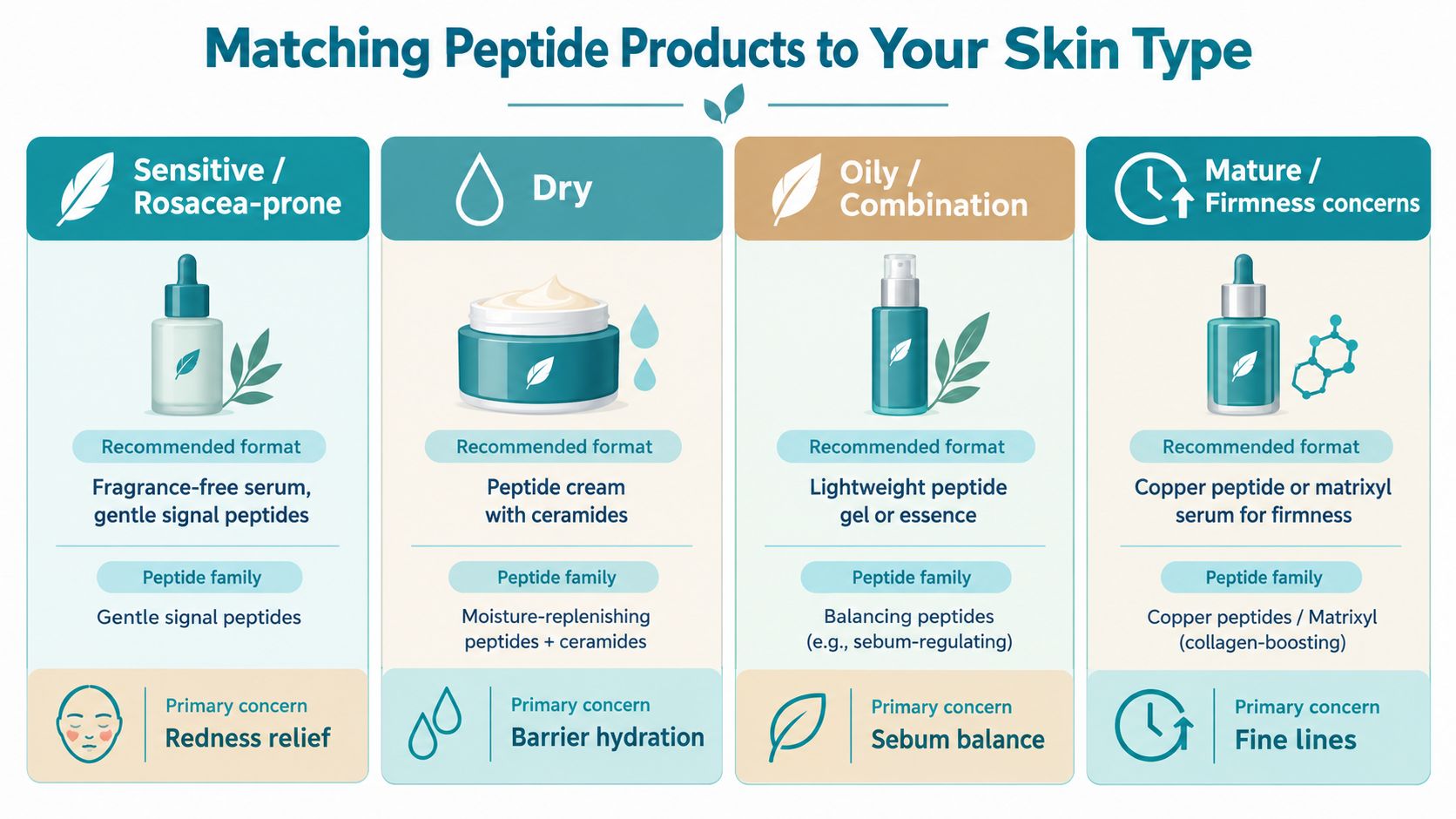
The best peptide format is the one you'll use consistently without making the rest of your routine uncomfortable. Product selection should begin with skin feel and primary concern, then move to peptide family. A signal peptide in a lightweight serum may suit someone who dislikes residue, while the same broad category in a richer cream may be more practical for someone whose skin feels dry.
Sensitive or easily uncomfortable skin
Choose a fragrance-free serum or simple moisturizer with a short ingredient list. Signal peptides such as palmitoyl pentapeptide-4 may be a reasonable starting point, especially when the formula also contains straightforward humectants and doesn't pile on multiple exfoliating acids. “Gentle” describes a formula experience, not a guarantee for every individual.
Patch-testing remains sensible because a person may react to fragrance, preservatives, botanical extracts, or another part of the formula rather than the peptide itself. Peptides should support a routine that feels manageable, not force you to tolerate a product that stings.
Dry skin
A richer peptide moisturizer can pair the peptide with emollients, squalane, ceramides, and humectants. This format may feel more comfortable than layering several watery products, particularly at night. Texture is doing real work here: a comfortable cream makes regular application easier.
Oily or combination skin
Look for a lightweight gel, essence, or serum that doesn't leave a heavy finish. A copper peptide or another short-chain peptide may appear in these formulas, but the name alone shouldn't decide the purchase. Check whether the base fits your preferences and whether the product layers cleanly with sunscreen or makeup.
Mature-looking skin and visible fine lines
A peptide serum under a peptide moisturizer can create a simple two-step routine, while a retinol product or antioxidant can serve a different role on a separate occasion if your skin tolerates it. Peptides don't need to replace every other active. They can occupy a supportive place in a routine designed around consistency.
Common Misconceptions About Peptide Skincare
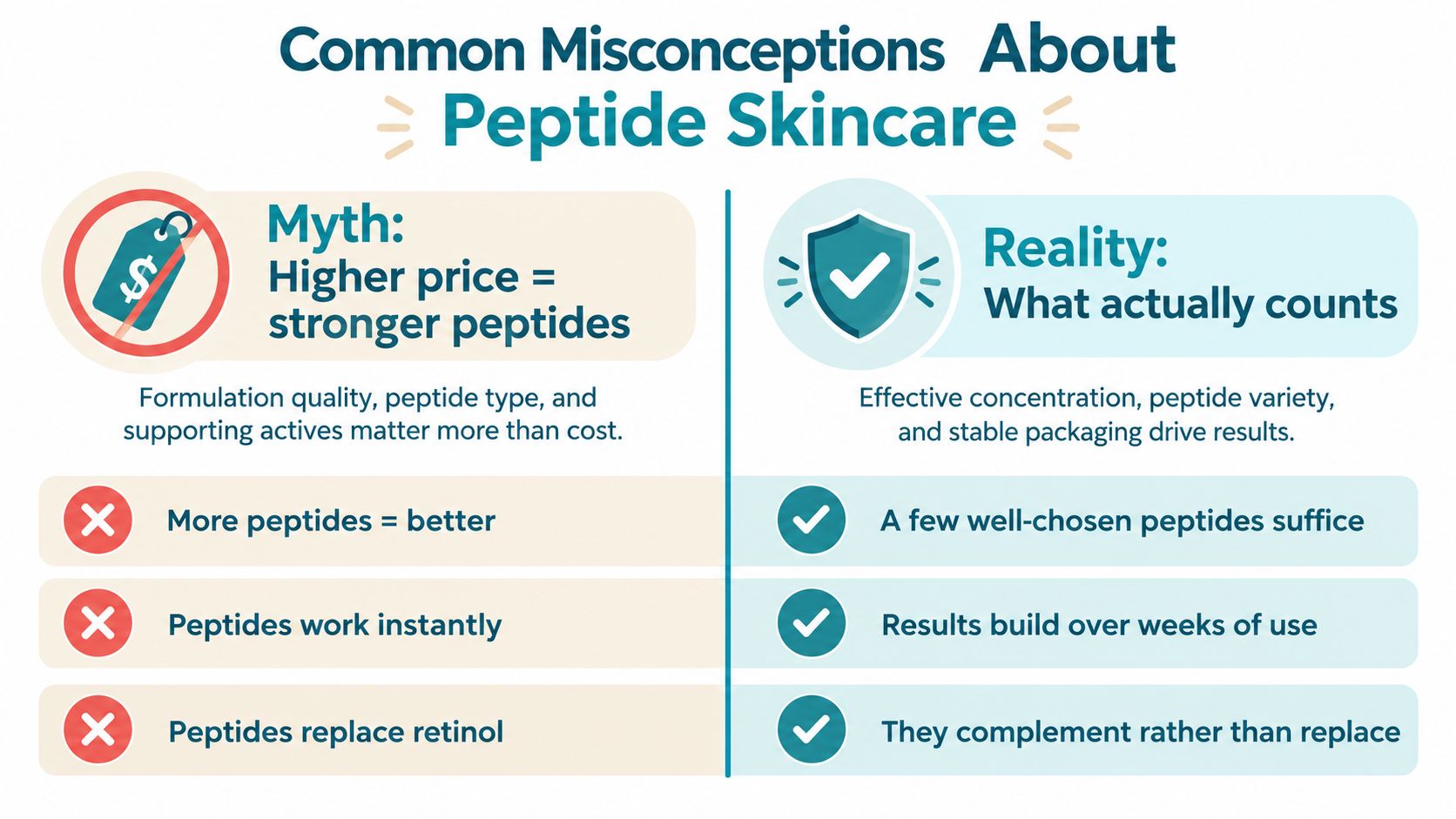
A higher price doesn't prove a stronger peptide formula. Peptide type, formula stability, supporting ingredients, packaging, and transparency are more useful evaluation points than the price tag.
Peptides also don't automatically replace retinoids or vitamin C. They work through different proposed pathways and can complement other cosmetic actives rather than duplicate them. If your routine already includes a tolerated retinoid or antioxidant, adding a peptide product should simplify your plan, not create an overcrowded stack.
The word “peptide” on a label doesn't guarantee a meaningful amount. Some products list a peptide near the end of the INCI list, while others use proprietary complexes without revealing the concentration of each component. More named peptides aren't necessarily better either. A formula with a few well-selected peptides may be easier to evaluate than one with a long list of trace-level ingredients.
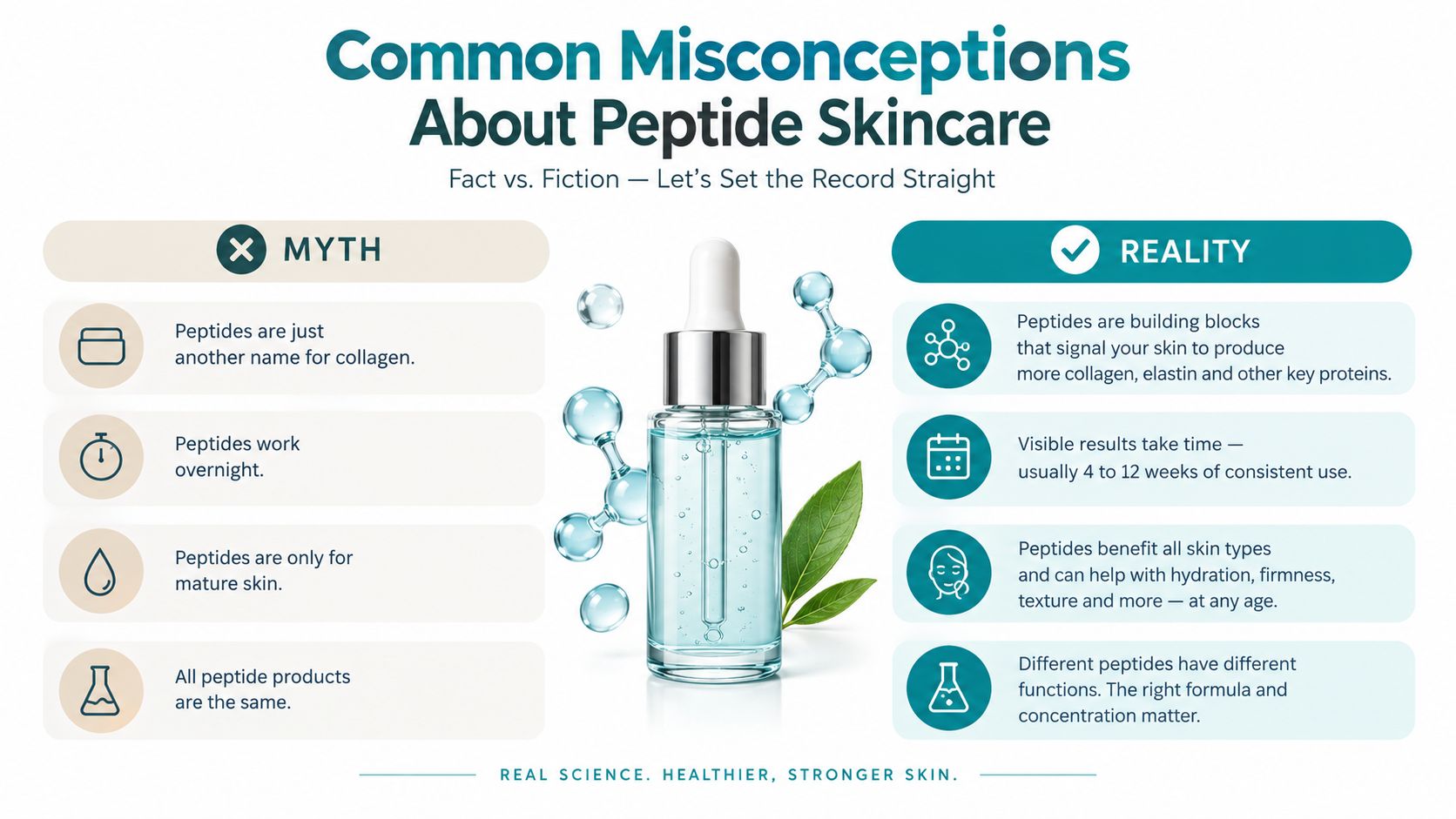
The honest evidence picture is mixed. Laboratory and shorter-term clinical research supports interest in particular peptide mechanisms, but long-term, direct comparisons with established active categories remain limited. The Cleveland Clinic's discussion of peptides for skin similarly presents possible benefits as a developing area rather than a guaranteed outcome.
Cosmetic language matters too. Etsy's policy prohibits disease and medical-condition claims, including claims that an item treats, mitigates, diagnoses, or cures a condition, or is as effective as an analgesic, antibiotic, antiseptic, antiviral, anti-inflammatory, steroid, vaccine, decongestant, or prescription drug. It also bars claims that an item is FDA-approved under the policy language documented here. Responsible product descriptions should stay with cosmetic appearance, texture, hydration, and routine use.
A Simple Checklist for Choosing Peptide Products
Use this quick filter before buying:
- Match the format: Choose a serum for a targeted layer, a moisturizer for daily comfort, or an eye cream for the eye area.
- Find a named peptide: Look for ingredients such as palmitoyl pentapeptide-4, copper tripeptide-1, or acetyl hexapeptide-8, preferably easy to locate in the list.
- Assess the supporting base: Glycerin, hyaluronic acid, ceramides, suitable emollients, and tolerated complementary actives can make the formula more practical.
- Match the texture: Gel-serums often suit oily or combination preferences, while richer creams may suit dry or mature-feeling skin.
- Patch-test first: Individual sensitivity varies, even when a product is marketed as gentle.
- Set a realistic horizon: Peptide products are better judged through consistent use over weeks to months, not by an overnight change.
For application order and routine placement, this guide to using peptide serum can help. Skin Perfection offers ready-made skincare products and lotion-making supplies for shoppers and DIY formulators who want to compare peptide formulas or build custom hydration products. Visit Skin Perfection to explore cosmetic products and formulation ingredients, then choose based on your skin type, preferred format, and the evidence visible on the label.