

 Buy with Prime


Does the copper peptide in an eye cream do anything, or does it sit in the ingredient list to make the formula sound advanced? Product pages tend to answer with the same phrase, peptides for anti-aging, and skip the part that decides whether the cream suits your eyes at all. The peptide is one input among several, and the rest of the formula, the packaging, and the acids or retinoids already sitting in your routine carry just as much weight. Two readers can buy the same copper peptide eye cream and get two different outcomes, one pleased and one blotchy, because their skin and their routines aren't the same.
That gap is worth closing first: what the peptide does, what the published studies measured, and where the label has to earn your trust before you spend anything.
Table of Contents
- What Copper Peptides Do and What the Research Shows
- Label Checks for a Quality Copper Peptide Eye Cream
- Copper Peptide Eye Cream Compared With Other Eye Actives
- How to Use Copper Peptide Eye Cream Step by Step
- Who Should Take Extra Care Around the Eyes
- Decide Whether to Buy
What Copper Peptides Do and What the Research Shows
In nearly every eye cream that lists a copper peptide, the active is GHK-Cu, glycyl-L-histidyl-lysine bound to a copper(II) ion. Think of it as a message rather than a filler. It doesn't plump the surface the way a humectant does. It signals skin cells to take up the work of building their support structures, and the visible change arrives slowly.
That signaling is fairly well mapped in laboratory work. Mechanistic research indicates GHK-Cu can influence fibroblast and keratinocyte behavior, shift extracellular-matrix turnover, and move the balance between matrix metalloproteinases and their inhibitors. That matters around the eyes, because periocular aging involves reduced dermal support and slower turnover. It doesn't follow that a cream will erase wrinkles, dark circles or puffiness, and a page that promises exactly that has walked past its evidence.
Why the eye area is a special case
The skin around the eye is thin, and the support underneath it thins with age, so crow's feet and crepey texture usually show there before the same changes reach the cheeks. Thin skin also means a formula that felt fine on your jaw can sting at the orbital rim. This is a test of formulation quality as much as of the peptide.
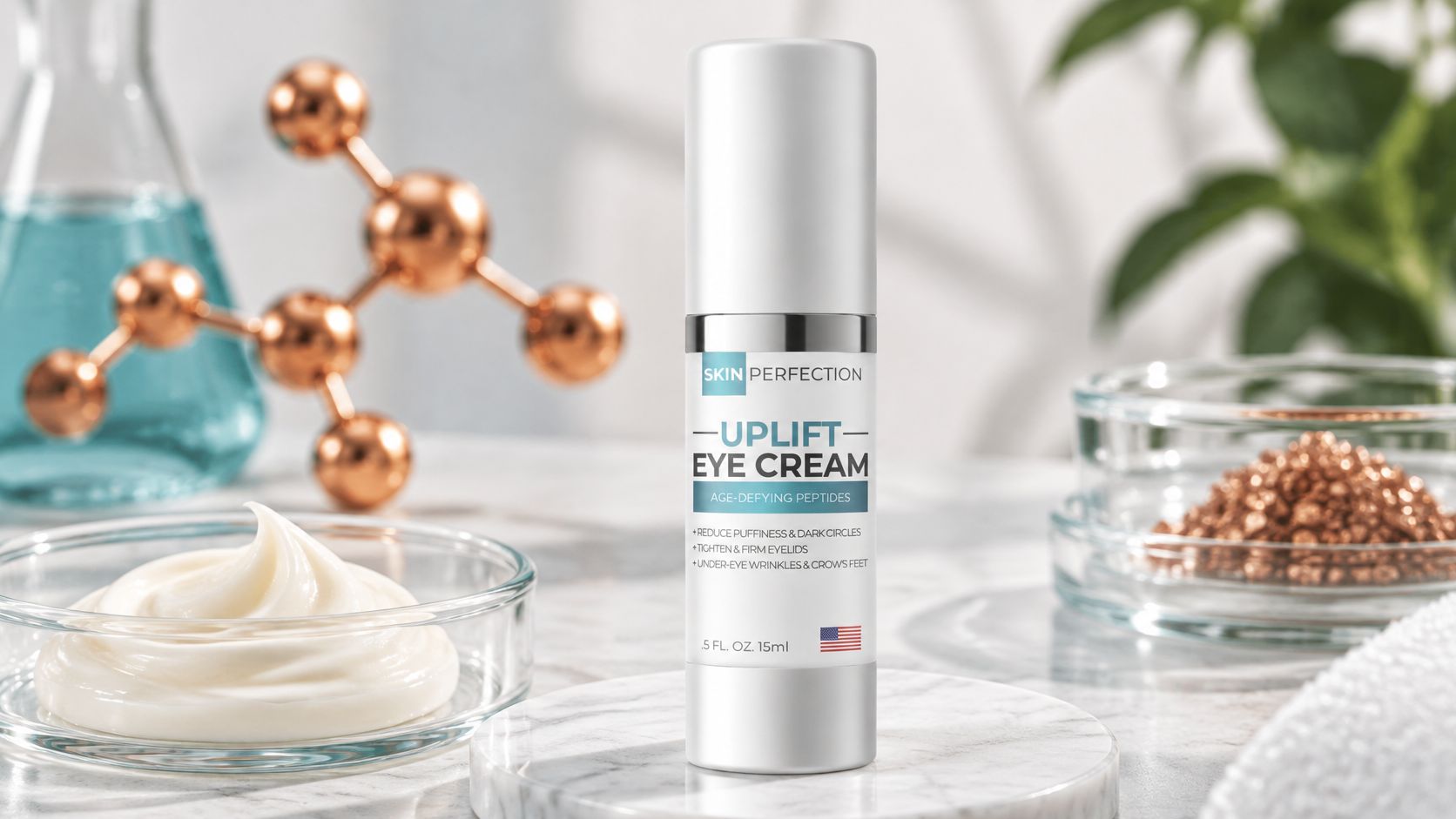
Here's the format many meet first, a cream built around a blend of peptides rather than one ingredient doing all the work.
Where the evidence comes from
A 2015 peer-reviewed review traces the research back to 1973, when biochemist Loren Pickart isolated the human tripeptide from albumin and observed that it encouraged aged human liver tissue to synthesize proteins associated with younger tissue. The same review summarizes a 12-week facial-cream study involving 71 women with mild to advanced photoaging, which reported improvements in skin laxity, clarity, fine lines, wrinkle depth, skin density and skin thickness.
A smaller human histologic comparison found procollagen synthesis after one month of topical GHK-Cu in approximately 70% of treated volunteers, against 50% for vitamin C and 40% for retinoic acid (review of GHK-Cu mechanisms and trial data). Read that as a small study with its own protocols, not as a head-to-head facial trial, and don't carry the numbers straight over to a modern eye cream.
The review is also candid that the human evidence base is smaller than the volume of cosmetic marketing suggests. Much of it comes from small studies, laboratory experiments, or formulas carrying several other actives, so a good result can't be pinned on the peptide alone. The 71-woman, 12-week trial is a real milestone, not a guarantee that every copper cream behaves the same way.
What to expect: gradual changes in texture and the look of fine lines over weeks of steady use, not a lifted lid after one application.
| Study or source | Participants | Duration | What it supports |
|---|---|---|---|
| 1973 discovery by Loren Pickart | Aged human liver tissue in the laboratory | Laboratory observation | Protein synthesis linked to younger tissue |
| 2015 review, facial-cream study | 71 women with mild to advanced photoaging | 12 weeks | Laxity, clarity, fine lines, wrinkle depth, density, thickness |
| Small histologic comparison | Small group of volunteers | One month | Procollagen synthesis in about 70% of GHK-Cu users, versus 50% for vitamin C and 40% for retinoic acid |
| Randomized, double-blind nano-lipid formulation | Human volunteers, group size not stated in the published report | Eight weeks, twice daily | Shows how delivery systems may affect topical availability |
If the biology is what you came for, our guide to skin biology and copper peptides goes deeper into how the peptide interacts with skin cells.
Label Checks for a Quality Copper Peptide Eye Cream
A well-built copper peptide eye cream says what's inside it. A weak one hides behind a phrase. Most of the difference is visible on the product page in about two minutes, before any money changes hands.
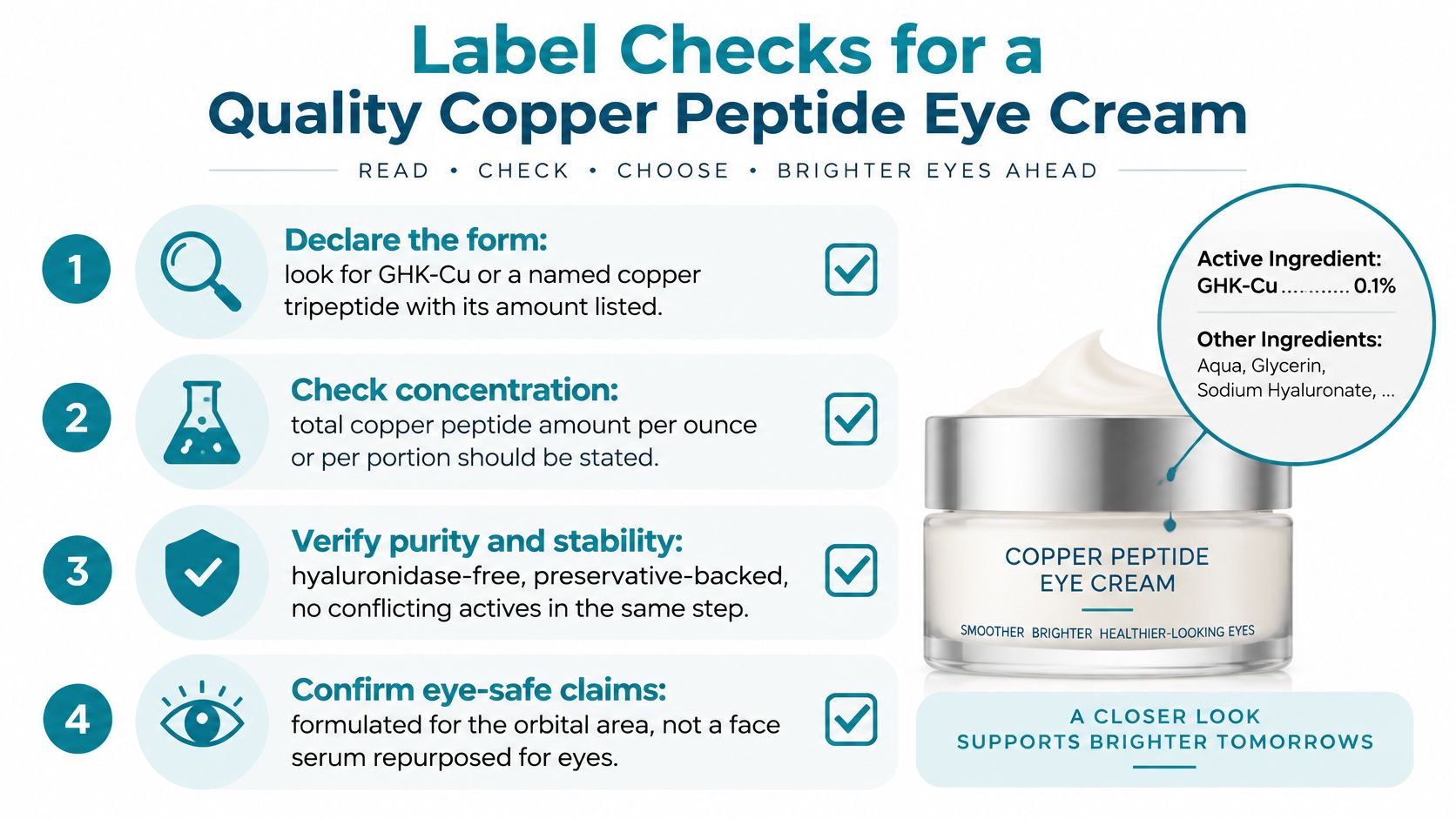
Here are four checks to run in order, then the label details that separate a real specification from decoration.
| Check | What to look for | Red flag |
|---|---|---|
| Copper peptide form | GHK-Cu or copper tripeptide-1 named, with amount stated | Only 'peptide complex' with no named form or amount |
| Supporting actives | Actives matched to your concern, such as caffeine for puffiness | Long list of strong actives crammed into one thin eye cream |
| Packaging | Opaque airtight tube or pump | Clear open jar exposed to light and air |
| Preservation and pH | Preservative system and pH listed | No preservative in a water-based formula, no pH information |
| Fragrance | Fragrance-free formula | Added fragrance or essential oils near the eye |
| Patch-test guidance | Clear usage and caution instructions on the label | No usage or caution information |
The form and the amount come first
Look for GHK-Cu or copper tripeptide-1 by name, followed by a figure. A generic "peptide complex" gives you no way to compare one product with another, and if no concentration is printed, ask the manufacturer before buying. A percentage is the only honest basis for comparing two creams.
Match the supporting actives to your concern
Caffeine is the usual pick for a puffy morning look, and hyaluronic acid for hydration. What you don't want is a thin eye cream loaded with a long list of strong actives, because each one adds irritation risk to skin that's already delicate.
Packaging and preservation decide whether the peptide survives
An opaque, airtight tube or pump protects peptides from light and oxygen. A clear open jar is a warning sign, since every opening exposes the formula to both. In any water-based formula, look for a preservative system and a stated pH, and treat their absence as a question for the maker. Fragrance-free is the safer default near the eye, because added fragrance and essential oils are common irritants.
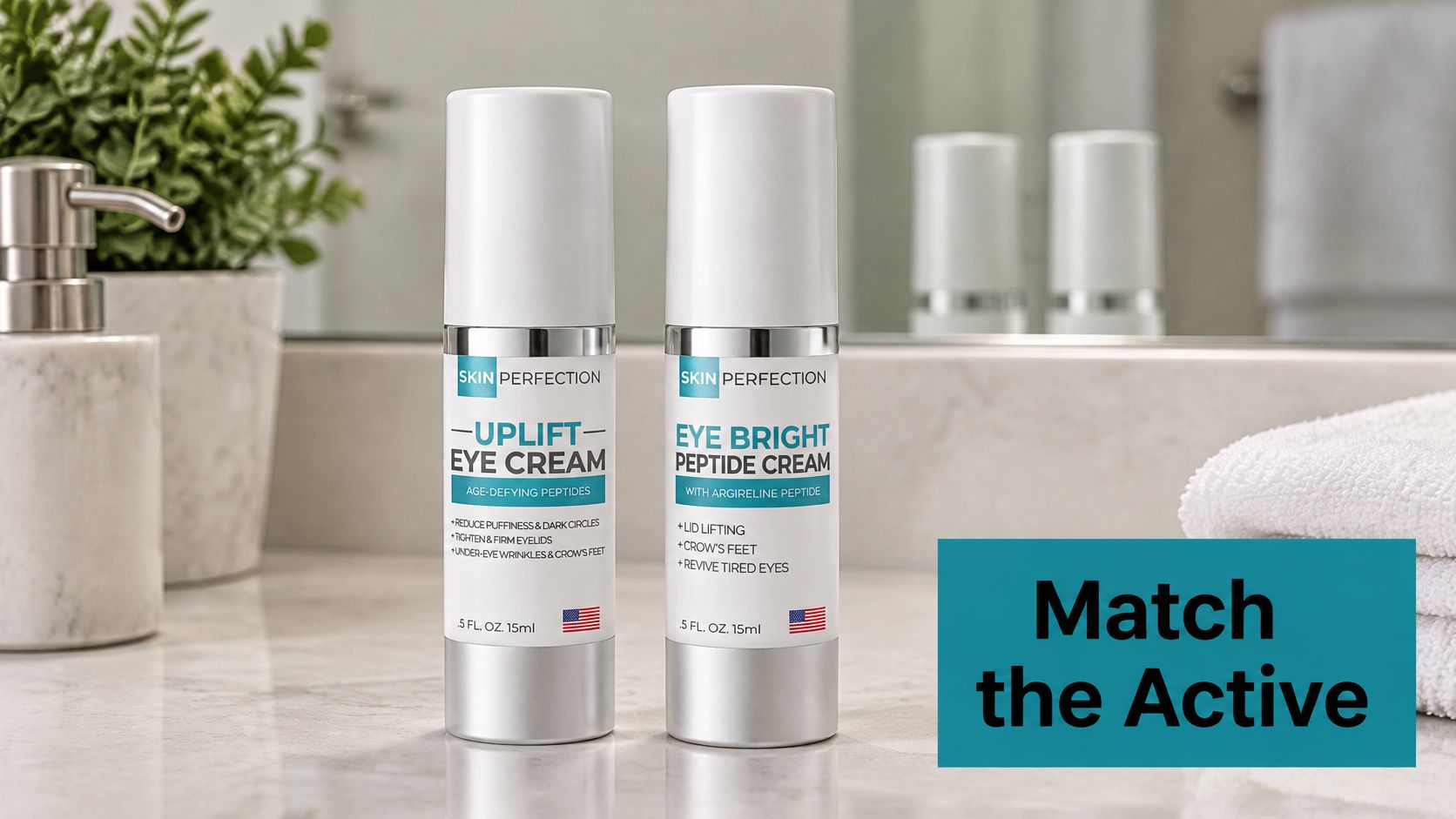
For the vocabulary on the back of the pack, our guide to reading a skincare label explains the INCI order and what each listing position implies. The Uplift Eye Cream page, for instance, names copper peptides alongside Argireline, Haloxyl and licorice root and states a peptide content above 48%, which is the kind of disclosure that makes comparison possible.
Wording that shouldn't be there
The FDA guidance on cosmetic labeling claims notes that cosmetics don't receive FDA approval before market and that the agency keeps no list of approved claims. Any "FDA approved" badge on a listing has no basis, which is why our own product pages stay with appearance-related wording. Judge a cream on its ingredient list, not on a seal it isn't entitled to.
Copper Peptide Eye Cream Compared With Other Eye Actives
Most eye creams blend several actives, so the choice starts with the visible concern rather than with the peptide name. Copper peptides sit in a crowded field, and each neighbor has a different evidence profile and a different irritation risk at the orbital rim.
| Active | Main visible target | Evidence strength | Irritation risk near eyes |
|---|---|---|---|
| Copper peptides (GHK-Cu) | Fine lines, texture, firmness | Mechanistic and small human studies | Low to moderate, higher in multi-active formulas |
| Caffeine | Puffiness and dullness | Short-term cosmetic studies | Low |
| Acetyl hexapeptide-8 (Argireline) | Expression lines | Supplier research and small studies | Low |
| Niacinamide | Tone and texture | Widely used cosmetic ingredient with moderate evidence | Low to moderate |
| Retinol | Fine lines and texture | Strong cosmetic evidence | Moderate to high near the eye |
| Hyaluronic acid | Hydration and plumper look | Well studied as a moisturizer | Low |
Choose by concern, then by tolerance
Say your main complaint is a soft, puffy look under the eyes most mornings. Caffeine is the active that speaks to that, and a copper peptide cream won't change it much. If crow's feet and crepey texture are the issue, copper peptides and Argireline are the more sensible starting points. If dark circles are the concern, neither of those is the lead act, and you're looking at a different ingredient list entirely.
Tolerance comes second. A reader whose skin stings easily may do better with a shorter formula, even if the longer one lists more actives. Two actives aimed at the same concern in one thin cream rarely double the benefit; they more often double the irritation risk.
Where copper peptides sit against retinol
Retinol has the stronger cosmetic evidence for fine lines, and it also has the sharper adjustment period near the eye. Copper peptides are the gentler option, which is why so many people use one in the morning and the other at night. Our copper peptides vs retinol comparison sets out how the two fit into one routine without stacking irritation.
If you're weighing textures as well as actives, AOX eye gel guide is a useful companion read on how a gel format behaves on the orbital area.
Disclosure matters here too. The Eye Bright Argireline Cream prints its peptide percentages on the page, including 25% Argireline and 15% Matrixyl 3000 alongside Haloxyl and licorice extract, and that level of detail is what you should press every brand to provide.
How to Use Copper Peptide Eye Cream Step by Step
A good cream applied badly is a wasted purchase. The routine below is short, and each step exists to keep a delicate area comfortable.
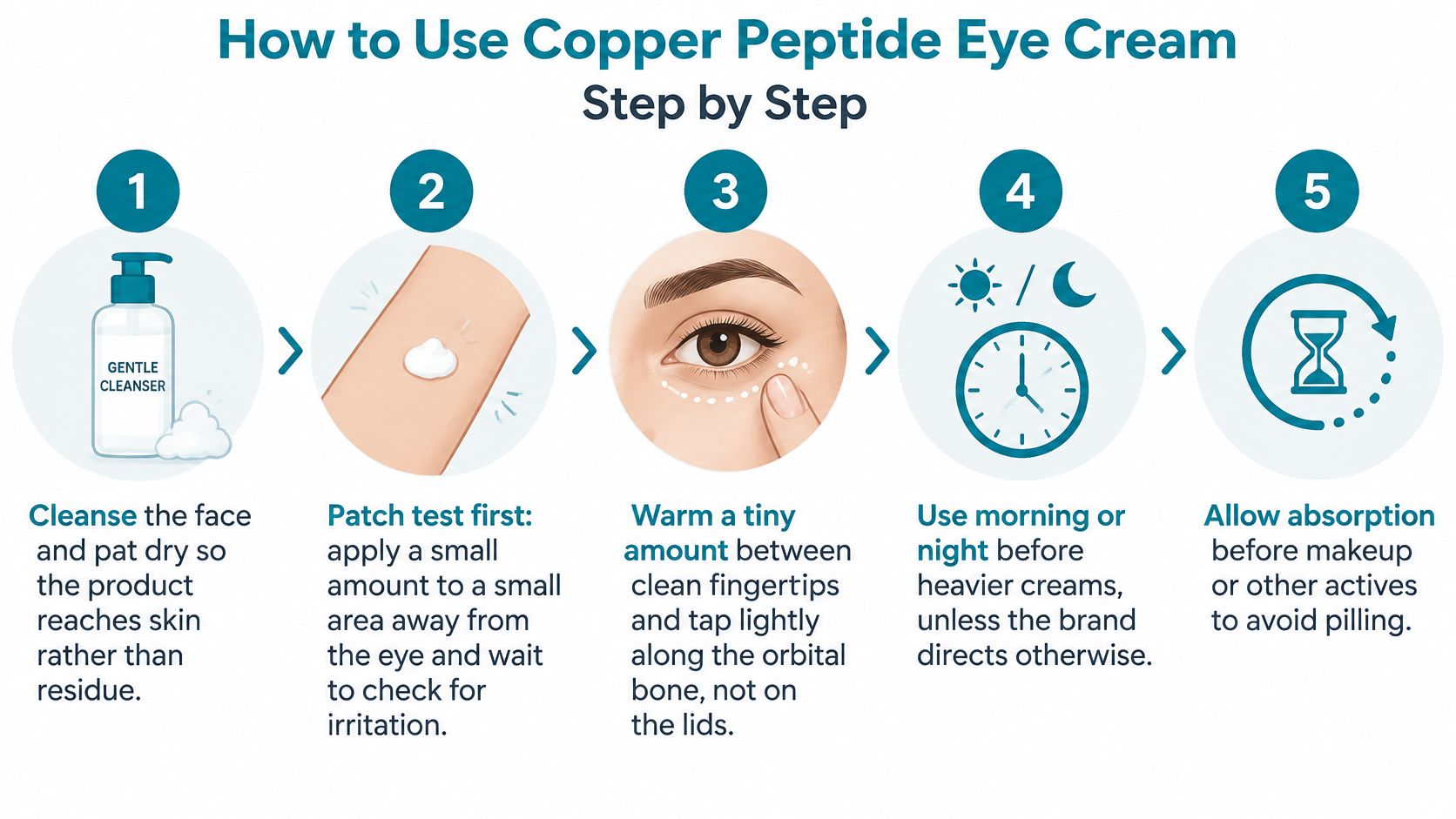
- Cleanse and pat dry. Residue from cleanser or makeup sits between the cream and your skin, so pat the area dry and start with a clean surface.
- Patch test before the first full use. Apply a small amount to a small area away from the eye, such as behind the ear or on the side of the neck, and watch it over several days. Burning, redness or itching on day three tells you what one application can't.
- Take a grain of rice per eye. That's the working measure, warmed between clean fingertips. More product doesn't absorb better; it just migrates.
- Tap along the orbital bone. The bony rim around the eye is the target. Keep the cream out of the eye, off the lash line and off the lid itself.
- Let it absorb for about a minute. Then makeup or a heavier cream goes on top without pilling.
- Place it correctly in the routine. Morning, after cleanser and any serum, before moisturizer and sunscreen. Night, after cleansing, before the night cream.
- Stop if a reaction persists. Rinse with water if burning, stinging or swelling doesn't settle, and leave the area alone until it does.
Here's the same sequence in one view, from the patch test to the wait before makeup.
Why the eye cream goes before the heavier cream
Eye creams are thinner than face moisturizers and absorb faster, so they need first contact with clean skin. Applied after a rich cream, the eye product mostly sits on top of it. If you're layering a serum underneath, our guide to layering skincare serums covers the order that keeps each step from blocking the next.
What the formula has to survive
Formulation quality is the technical variable most pages ignore, because peptide activity depends on holding the intended copper complex together while limiting degradation and irritation in a sensitive area. Published reviews describe GHK-Cu as a bioavailable chelated form capable of interacting with skin cells, and a randomized, double-blind study used a nano-lipid-carrier formulation twice daily for eight weeks, showing how delivery systems may improve topical availability (review of copper peptide formulation and use). A finished eye cream should be assessable for pH, preservative compatibility, exposure to oxygen and light through its packaging, peptide assay across shelf life, and stability after repeated opening.
Keep the wider routine simple
Our routine advice is to keep a gentle cleanser, a moisturizer and a daily sunscreen, and add one targeted serum or eye cream for the main concern, used morning and night. When copper peptides share a routine with strong acids or retinoids, alternate nights or separate them by time of day rather than layering all three at once. Consistent twice-daily use for several weeks is what gives you something to judge; a few days tells you almost nothing.
Who Should Take Extra Care Around the Eyes
The American Academy of Dermatology notes that reported copper peptide benefits come from small, preliminary trials, and that users may experience erythema, burning, irritation or dermatitis, particularly when copper peptides are combined with multiple active ingredients (AAD summary of copper peptide evidence). Copper is also a weak but not impossible sensitizer: a review of patch-test literature found an average of 3.8% positive results among people already evaluated for suspected exposure or related symptoms. That's a small share, and it's a real one.
| Situation | Precaution | Stop and see a professional if |
|---|---|---|
| Sensitive or reactive skin | Patch test for several days and choose a fragrance-free formula | Burning or redness lasts after stopping |
| Contact-lens wearers | Apply, let it absorb fully, then insert lenses | Blurred vision, discomfort or eye irritation |
| Eczema or blepharitis | Ask a dermatologist before first use | Any flare, swelling or crusting |
| Routine with acids or retinoids | Alternate nights or separate by time of day | Peeling, stinging or persistent redness |
| DIY formulators | Test the finished formula for pH, preservation and stability | Separation, odor change or irritation in patch tests |
The questions people actually ask
Keep the product off the lash line and waterline, full stop; nothing in a cosmetic eye cream belongs on either. On concentration, the research reviewed here doesn't establish a safe or effective copper level for the eye area, so no percentage is recommended. Ask the maker for the stated amount, its stability data, and evidence that the finished formula, not just the raw peptide, was tested.
Contact-lens wearers should apply, wait for full absorption, then insert lenses. Anyone with eczema or blepharitis should get a dermatologist's view before the first use rather than after a flare.
The principle to hold onto: "clean," "natural" and "peptide-focused" describe marketing, not tolerance. Irritation usually comes from the whole formula, not the copper peptide alone.
If your eyes water easily at the lash line, our guide to eyelash serums for sensitive eyes covers the precautions that apply to that area too.
Decide Whether to Buy
Match the concern to the active before you compare brands. Copper peptides suit fine lines and texture; dark circles and puffiness usually call for a different lead ingredient, and no amount of peptide will substitute for the right one. For crow's feet, the key ingredients we look for are Argireline, Snap-8 and eye peptides. For dark circles, we look for Haloxyl and Regu-Age.
A product page that prints its peptide percentages gives you something to check against a list. One that doesn't leaves you guessing, and guessing is expensive.
Then take three steps, in this order.
- Check the shortlist against the list. A named copper peptide with its amount, supporting actives that match your concern, opaque airtight packaging, a preservative system with a stated pH, and no fragrance.
- Run a multi-day patch test. Several days, not several minutes, before the first application at the orbital rim.
- Judge it at the 12-week mark. Set the goal before you start, then assess texture, the look of fine lines and comfort. Not lifting, not erased dark circles.
If a cream fails the packaging or fragrance check, skip it whatever peptide it lists. Nothing is guaranteed here, and a formula that irritates you nightly has already lost.
Skin Perfection carries eye creams built around disclosed peptides rather than mystery blends, along with the lotion-making supplies to blend your own base if you'd rather set the concentration yourself. Run the label checks, patch test for a few days, and give whichever formula you choose a full 12 weeks before you judge it on texture and comfort. Visit Skin Perfection to browse the eye cream range and the ingredient guides that go with it.